How to Improve Your Push-Ups and Forearm Plank for the Navy PRT
Technique that counts, the mistakes that cost repetitions, and a simple six-week progression for both events.
In this guide
Push-ups and the forearm plank are two of the three events in the Navy Physical Readiness Test. They are also the two where technique costs people the most: repetitions that do not meet the standard do not count, and a plank ends the moment your form breaks. Train to the standard from the first day.
New to the test? Start with how the Navy PRT works.
Push-ups: technique that counts
- Hands roughly shoulder-width apart, directly beneath your shoulders.
- Body in one straight line from head to heels. No sagging hips, no raised backside.
- Lower under control until your upper arms are at least parallel to the ground.
- Push all the way up until your arms are straight.
- Breathe: in on the way down, out on the way up.
Mistakes that cost repetitions
- Half repetitions — not going low enough, or not locking out at the top.
- Hips dropping as you tire.
- Starting too fast and burning out in the first thirty seconds.
- Elbows flared straight out to the sides, which strains the shoulders. Aim for about 45 degrees from your body.
A six-week push-up progression
First, find your maximum number of strict push-ups in one set. Then train three days a week, with a rest day between.
| Weeks | Each session | Rest between sets |
|---|---|---|
| 1–2 | 5 sets at about half your maximum | 60–90 seconds |
| 3–4 | 5 sets at about 60 percent of your maximum, last set to near failure | 60 seconds |
| 5 | 4 sets at about 70 percent, plus one timed two-minute effort a week | 60 seconds |
| 6 | Reduce volume by a third; retest your maximum at the end of the week | 90 seconds |
If you cannot yet do five strict push-ups, begin with your hands on a bench or step and work down to the floor.
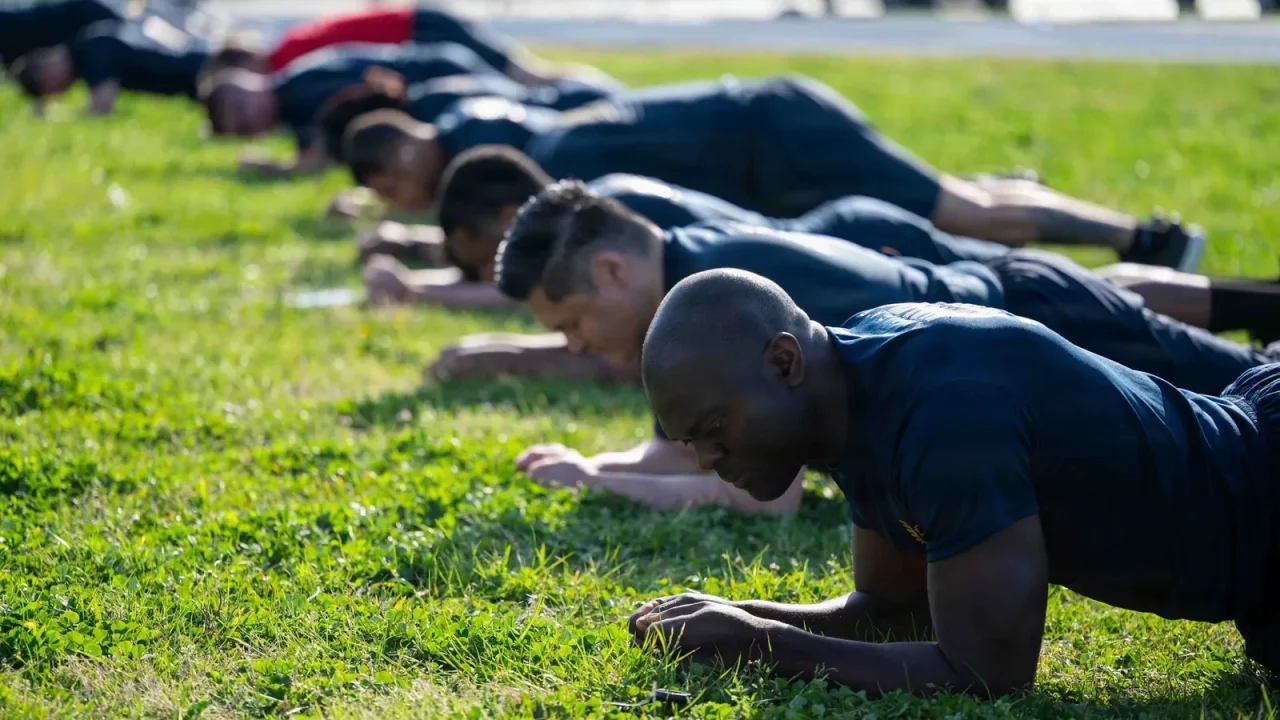
Forearm plank: technique that counts
- Elbows directly under your shoulders, forearms on the ground.
- Feet about hip-width apart, weight on your toes.
- Straight line from head to heels. Tuck your pelvis slightly and squeeze your glutes.
- Brace your stomach as if someone were about to prod it.
- Keep breathing. Holding your breath shortens your hold.
What ends the test early
In general terms, the event stops when you can no longer keep the position — typically hips sagging or lifting, knees touching down, or hands or feet moving. The exact rules are set out in the current Physical Readiness Program guide; read them so nothing surprises you on the day.
A six-week plank progression
| Weeks | Each session (three a week) |
|---|---|
| 1–2 | 4 holds at about half your best time, 60 seconds rest |
| 3–4 | 4 holds at about 60–70 percent of your best time, 45 seconds rest |
| 5 | 3 holds at about 80 percent, plus one all-out hold a week |
| 6 | Two light sessions, then retest |
Putting it together
Push-ups and planks fit neatly after a run or on the days between runs. A simple week looks like this:
- Monday: easy run, then push-ups and planks
- Wednesday: intervals, then push-ups and planks
- Friday: steady run, then push-ups and planks
- Other days: rest or light activity
For the running side, follow our 8-week 1.5-mile run plan. A watch with a countdown timer makes plank sessions much easier to manage — see our watch guide.
Frequently asked questions
How many push-ups do I need for the Navy PRT?
It depends on your age and sex, and standards were revised for 2026. Check the current Physical Readiness Program guide from MyNavy HR.
Should I do push-ups every day?
Three or four days a week with rest in between is more effective for most people. Muscles and connective tissue need time to recover.
My wrists hurt during push-ups. What can I do?
Try a slightly wider or narrower hand position and keep your wrists under your shoulders. If pain continues, stop and get it checked.
How do I pace two minutes of push-ups?
Start at a steady rhythm you can keep for the first minute, and take short pauses in the up position before you reach failure rather than after.
Sources
Facts last checked against these sources: October 2026.
- MyNavy HR — Physical Readiness Program guides containing the official event rules and standards.
More like this
Keep reading
Navy PRT Explained: Events, How Scoring Works and How to Prepare
What the Physical Readiness Test involves, how it fits into the fitness assessment, what changed for 2026, and how to…
An 8-Week Training Plan for the Navy 1.5-Mile Run
Three runs a week, built around easy mileage, intervals and a weekly time trial — with a pace calculator to…

Best Running Shoes for Navy PRT Training
How to choose a running shoe for 1.5-mile training, and five long-running shoe lines worth trying on.