How to Make Chief in the Navy: The Board, the Timeline and How to Prepare
How the Navy chief petty officer board works today: eligibility, the two routes to selection, the full 2026 timeline, letters to the board, CPO Initiation, and a preparation plan that starts years out.
Some links on NavyMentor are affiliate links. If you buy through one, we may earn a commission at no extra cost to you. It never changes what we recommend. How this works
In this guide
You do not make chief by passing a test. You make chief when a board of senior leaders reads your record and decides you are ready. That board meets once a year. In 2026 the active-duty board met from 22 June to 17 July, the results came out on 5 August, and new chiefs pinned on their anchors on 16 September.
Because the board only sees what is in your record, making chief is really a multi-year project. The sailors who are selected are usually the ones who started preparing long before they were eligible.
This guide explains how the chief petty officer board works today, what makes you eligible, the full timeline for a board year, and what you can do, starting now, to give yourself the best chance. It is built on this year’s Navy messages. ⚓
Why making chief is different
Up to E-6, advancement is largely about measurable things: an exam, your evaluations and time in rate. Chief is not like that.
A chief petty officer is expected to lead sailors, train junior officers and be the technical expert all at once. No exam can measure that. So the Navy uses a board: experienced senior enlisted leaders and officers who read each candidate’s record and judge the whole person.
The board never meets you. It meets your record. Everything you want it to know has to be written down, in the right place, before it convenes.
Two routes: selection board or marketplace
This is new, and it confuses a lot of people. There are now two ways to be picked for chief on active duty.
| Senior Enlisted Marketplace | Legacy selection board | |
|---|---|---|
| Who | Most active-duty candidates | Communities that are exempt from the marketplace |
| What the board does | Screens you as qualified for chief | Selects you for advancement |
| What happens next | You compete for chief billets through the assignments process | You advance in the order the board sets |
| Result message | “Screening boards results” | “Advancement selection boards results” |
For the 2026 boards, the Navy said the marketplace did not apply to nuclear ratings, Musicians, Special Warfare Operators, Special Warfare Boat Operators, sailors in the Enlisted Aide and Flag Writer programmes, sailors in the Training and Administration of the Reserve (TAR) programme, or the Selected Reserve. Those candidates went before selection boards.
If you are in a marketplace rating, being screened means the board judged you ready to be a chief. You then have to be matched to a chief’s billet. Read the follow-on guidance in the results message carefully.
Are you eligible?
Each year’s message sets the exact requirements. These were the main ones for the 2026 boards.
| Requirement | What the 2026 message said |
|---|---|
| Board eligible on your profile sheet | You must show as selection board eligible in the correct rating and competitive group |
| Time in rate | A time-in-rate date of 1 January 2024 or earlier. A waiver is possible for sailors with an Early Promote evaluation |
| Security clearance | Required for a long list of ratings, plus all nuclear and submarine ratings |
| No approved Fleet Reserve request | Sailors with an approved request are not considered |
| Rating-specific rules | Some ratings have extra requirements, such as watch qualifications for nuclear-trained sailors |
| Stay eligible | You must remain eligible until the board adjourns |
Source: NAVADMIN 075/26, paragraph 6.
Check your profile sheet, then check it again
Your profile sheet shows whether the Navy’s system thinks you are eligible. The message warns that this information can change week by week, and tells both the sailor and the command to keep checking. You can sign up for an email alert whenever your sheet is updated.
If your sheet does not show you as board eligible and you believe you are, tell your Educational Services Officer straight away. Do not wait.
The board year, month by month
Here is how 2026 ran for active-duty candidates. The pattern is much the same each year.
| Date in 2026 | What happened |
|---|---|
| Spring | The board guidance message was released |
| 23 May | Deadline for rating changes |
| 11 June | Deadline for letters to the board |
| 22 June | Board convened |
| 17 July | Board adjourned |
| 4 August | Command leadership told; CPO Initiation began |
| 5 August | Results released by NAVADMIN |
| 15 September | Capstone event |
| 16 September | Pinning ceremony |
The Reserve board ran earlier. It convened on 1 June and adjourned in mid-June, with a letter deadline of 21 May. Reserve results were released in July.
Sources: NAVADMIN 075/26 and NAVADMIN 122/26.
What the board looks at
The board works from your official record. In practice that means three things.
- Your Official Military Personnel File (OMPF). Your evaluations, awards, qualifications, training and education.
- Your performance summary. A one-glance view of your evaluation history.
- Anything you send in a letter to the board. Only what is missing from your record.
You can view your own record on BUPERS Online. Do it months before the board, not the week before.
What boards tend to reward
Each board works to its own official guidance, so no list is definitive. But the same themes appear year after year in advice from serving chiefs:
- Sustained superior performance. Strong evaluations over several years, not one good year.
- Leadership. Jobs where you were responsible for people and results.
- Hard jobs done well. Sea duty, demanding billets and challenging tours.
- Qualifications. Warfare devices and the senior watch stations in your rating.
- Developing others. Sailors you mentored who advanced and qualified.
- Self-improvement. Education, certifications and professional reading.
- A clean record. No recent misconduct or fitness failures.
Board members read a great many records quickly. Evaluations that open with a clear ranking and specific results are far easier to credit than ones full of general praise. Give your chief the facts and numbers they need to write it well.
The letter to the board
You are allowed to write to the board. The letter exists for one purpose: to put in front of the board any document that should be in your record and is not.
- Review your record first. Compare your own files with what BUPERS Online shows.
- List what is missing. An evaluation, an award, a qualification, a degree.
- Send only what is missing. Do not resend what is already there.
- Use the right board number. Each board has its own. In 2026 there were separate numbers for the Selected Reserve, TAR, the active-duty screening board and the active-duty exempt ratings.
- Put your full name and DoD ID number on the letter and on every enclosure.
- Submit it electronically through the Navy’s selection board document system.
- Beat the deadline. In 2026 it was 11 June for active duty. Late letters are not seen.
The message is blunt about this. Documents sent to the eligibility office are not shown to the board, and letters to the board are not shown to the eligibility office. If you need something to count for both, it has to go to both.
A preparation plan that starts years out
Three or more years before you are eligible
- Earn your warfare qualification and work toward the senior watch stations.
- Ask for the hard jobs: leading petty officer, work centre supervisor, a tough collateral duty.
- Start, or finish, a degree. See our guide to Navy Tuition Assistance.
- Find a chief who will tell you the truth about your record.
One to two years before
- Check your record on BUPERS Online and fix anything missing.
- Make sure each evaluation tells a clear story of growing responsibility.
- Mentor junior sailors, and keep track of what they achieve.
- Keep your fitness assessments passing. See our guide to the fitness test.
The board year
- Read the board message the day it is released.
- Check your profile sheet every week.
- Confirm your security clearance is current.
- Send your letter to the board early, if you need one.
- Keep performing. Your current evaluation still matters.
If you are selected: CPO Initiation
Selection is followed by CPO Initiation. The Navy describes it as a command-led programme that turns selectees into effective leaders, with the focus on preparing for responsibility and not on tradition for its own sake.
In 2026 it began on 4 August and ended with a capstone event on 15 September. The pinning ceremony followed on 16 September. That is about six weeks.
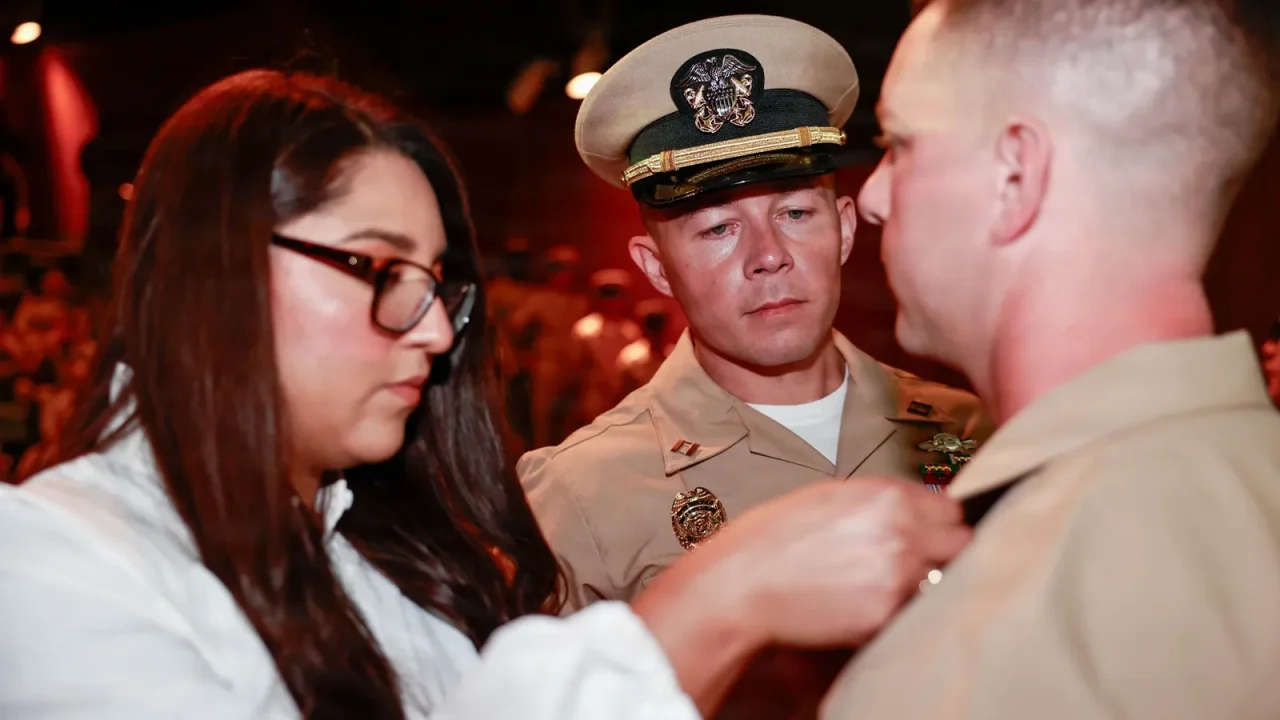
All required parts of initiation must be completed before you are frocked or promoted. On pinning day, a new chief’s anchors are usually pinned on by family and by fellow chiefs. The photo at the top of this guide shows exactly that.
If you are not selected
Most eligible sailors are not selected in any one year. It is hard to hear, but it is normal, and many chiefs were picked on their second, third or fourth look.
- Give yourself a day. Then congratulate the shipmates who made it. People notice how you handle it.
- Ask for an honest record review. Sit down with your command master chief or a chief who has sat on a board.
- Find the gap. Is it qualifications, leadership roles, evaluations or something missing from your file?
- Make a plan for the next twelve months. Pick the one or two things that would make the biggest difference.
- Ask for a Career Development Board. Our guide to Career Development Boards explains how.
Real-life situations
1. You are a new first class
You are years from the board, which is exactly when to start. Get qualified, take on leadership, and ask a chief to look at your record once a year.
2. Your record is missing an evaluation
Start the correction now through your admin office. If it is not fixed by the board year, include it in a letter to the board.
3. Your profile sheet says you are not eligible
See your Educational Services Officer immediately. Problems like a clearance issue or a wrong date take time to fix.
4. You were screened but have no billet yet
That is how the marketplace works. Follow the guidance in the results message and talk to your detailer and your Command Career Counselor.
5. Your spouse just made chief
Initiation is demanding and the hours are long. It ends on pinning day, and families are a big part of that ceremony. Plan to be there if you can.
Common mistakes (and the fix for each)
⚠️ Mistake: Never looking at your own record.
✅ Fix: Review it on BUPERS Online at least once a year.
⚠️ Mistake: Sending a letter full of things already in your record.
✅ Fix: Send only what is missing.
⚠️ Mistake: Missing the letter deadline.
✅ Fix: Submit it weeks early.
⚠️ Mistake: Assuming you are eligible.
✅ Fix: Check your profile sheet weekly in the board year.
⚠️ Mistake: Coasting once the board convenes.
✅ Fix: You must stay eligible until the board adjourns, and your reputation follows you.
⚠️ Mistake: Mixing up “screened” and “selected”.
✅ Fix: Know which route your rating is on and read the right message.
⚠️ Mistake: Starting to prepare in the year you become eligible.
✅ Fix: Start as a new first class, or earlier.
Pro tips
- Keep a running list of what you achieve. It makes evaluations and awards far easier to write.
- Ask to see a strong record. A mentor’s example shows you what good looks like.
- Take the job nobody wants, and do it well.
- Train your relief. Developing others is what chiefs do.
- Read. The Navy reading list is a good place to start.
- Look the part every day. Uniform, fitness and bearing are noticed long before a board meets.
- Be the chief before you are a chief. Act at the level you want to reach.
Books worth reading on the way to chief
These three come from the Naval Institute Press and are aimed at the stages either side of the board. We chose them by researching what each one covers and who it suits. We have not tested them hands-on, and we list the trade-offs. Read how we choose products.
| Product | Best for | Key feature | Price level | Link |
|---|---|---|---|---|
| Best for selecteesChief Petty Officer's Guide, Third Edition | First classes preparing for the board, and new chiefs | Fully revised third edition | Mid-range | See on Amazon (opens in a new tab) |
| Best for first classesPetty Officer's Guide | Building leadership skills before the board | Written by petty officers for petty officers | Mid-range | See on Amazon (opens in a new tab) |
| Best referenceThe Bluejacket's Manual, 26th Edition | Keeping general Navy knowledge sharp | The standard handbook for sailors | Mid-range | See on Amazon (opens in a new tab) |
Price level is a broad guide, not a live price. Scroll the table sideways on small screens.
Chief Petty Officer's Guide, Third Edition
Mid-range
A professional guide for chief petty officers from the Naval Institute Press. The publisher describes this third edition as fully revised. It is written for chiefs, but reading it as a first class shows you the job you are trying to earn and the standard you will be held to.
Ideal for: First class petty officers in their board years, selectees and new chiefs.
- Part of the Blue and Gold Professional Library
- Covers the role and duties of a chief
- Recently revised
- Author
- Paul A. Kingsbury
- Publisher
- Naval Institute Press
- Edition
- Third
- Format
- Hardcover
- Length
- 328 pages
- Published
- March 2025
What we like
- Aimed directly at the chief’s job
- Current edition
- From a trusted publisher
Trade-offs
- Stock can run low
- Hardcover price
- No book can stand in for a good mentor
Petty Officer's Guide
Mid-range
A professional handbook for Navy petty officers. The publisher describes it as written and edited by petty officers for petty officers. It covers the leadership and management skills that boards look for evidence of in your record.
Ideal for: Second and first class petty officers building toward the board.
- Part of the Blue and Gold Professional Library
- Focused on leading at the petty officer level
- Written by experienced sailors
- Authors
- Paul A. Kingsbury and Daniel M. Richard
- Publisher
- Naval Institute Press
- Format
- Hardcover
- Length
- 296 pages
- Published
- March 2022
What we like
- Practical and relevant
- Useful for several years of a career
- From a trusted publisher
Trade-offs
- Hardcover price
- Policy details can change after printing
- Not a substitute for current instructions
The Bluejacket's Manual, 26th Edition
Mid-range
The long-standing handbook for enlisted sailors, covering customs, ranks, ships and Navy life. Chiefs are expected to know the basics cold and to teach them. This is the book to keep within reach when a junior sailor asks you a question.
Ideal for: Leaders who train junior sailors.
- Covers customs, ranks and Navy basics
- Written for enlisted sailors
- Long-running standard reference
- Authors
- Thomas J. Cutler, Mark T. Hacala and Paul A. Kingsbury
- Publisher
- Naval Institute Press
- Edition
- 26th
- Length
- 712 pages
- Published
- April 2023
What we like
- Broad and readable
- Trusted publisher
- Useful through a whole career
Trade-offs
- A thick book to carry
- Policy can change after printing
- Not a substitute for official guidance
When do results come out?
See this year’s dates for every pay grade and where to check.
Frequently asked questions
How do you make chief in the Navy?
You must be board eligible in your rating and meet the time-in-rate and clearance requirements. A board of senior leaders then reviews your official record and either selects you for advancement or, in marketplace ratings, screens you as qualified for chief.
When does the chief petty officer board meet?
Once a year. In 2026 the Reserve board convened on 1 June and the active-duty board met from 22 June to 17 July.
When are chief results released?
In 2026, Navy Reserve results were released in July and active-duty results on 5 August, by NAVADMIN. Results are also posted on BUPERS Online.
What is a letter to the board?
It is a way to give the selection board documents that are missing from your official record, such as an evaluation or an award. It must reach the board by the deadline in that year’s message.
What is the Senior Enlisted Marketplace?
It is a route in which a board screens sailors as qualified for chief, and those sailors then compete for chief billets through the assignments process. Some communities are exempt and still use selection boards.
What is CPO Initiation?
It is the command-led programme that prepares chief selectees for their new responsibilities. In 2026 it ran from 4 August to a capstone event on 15 September, with pinning on 16 September.
Your quick-reference checklist
- Start early. Years, not months.
- Get qualified and take the leadership jobs.
- Review your record on BUPERS Online every year.
- Read the board message as soon as it is released.
- Check your profile sheet weekly in the board year.
- Confirm your clearance.
- Send a letter to the board only for what is missing, and send it early.
- Know your route: marketplace screening or selection board.
- Results: BUPERS Online and NAVADMIN.
- Not selected? Get an honest review and go again.
Nobody is owed anchors. But the path to them is not a mystery either. Do the hard jobs, look after your sailors, keep your record straight and let the board see who you already are. ⚓
Sources
Facts last checked against these sources: October 2026.
- NAVADMIN 075/26: guidance for the fiscal year 2027 chief petty officer selection and screen boards, including eligibility, timelines and letters to the board.
- NAVADMIN 122/26: Chief Petty Officer Initiation guidance and key dates for 2026.
- NAVADMIN 187/26 and 186/26 (5 August 2026): active-duty E-7 selection and screening results.
- MyNavy HR — CPO Selection Boards: the Navy’s page for each board cycle.
More like this
Keep reading

Navy Advancement Results: When They Come Out and How to Check (2026)
When Navy advancement results come out and exactly where to find them. E-5 and E-6 exam cycles, chief and senior…
Career Development Boards (CDBs): Schedule, Purpose and How to Document Them
When Navy Career Development Boards are due, who runs them, what they should cover, and how to document a CDB…

Navy Reading List 2026: All 30 Books on the CNO Professional Reading Program
All 30 books on the current CNO Professional Reading Program, with a one-line summary of each, the four groups explained,…