Career Development Boards (CDBs): Schedule, Purpose and How to Document Them
When Navy Career Development Boards are due, who runs them, what they should cover, and how to document a CDB properly, for sailors and for the leaders who run the boards.
Some links on NavyMentor are affiliate links. If you buy through one, we may earn a commission at no extra cost to you. It never changes what we recommend. How this works
In this guide
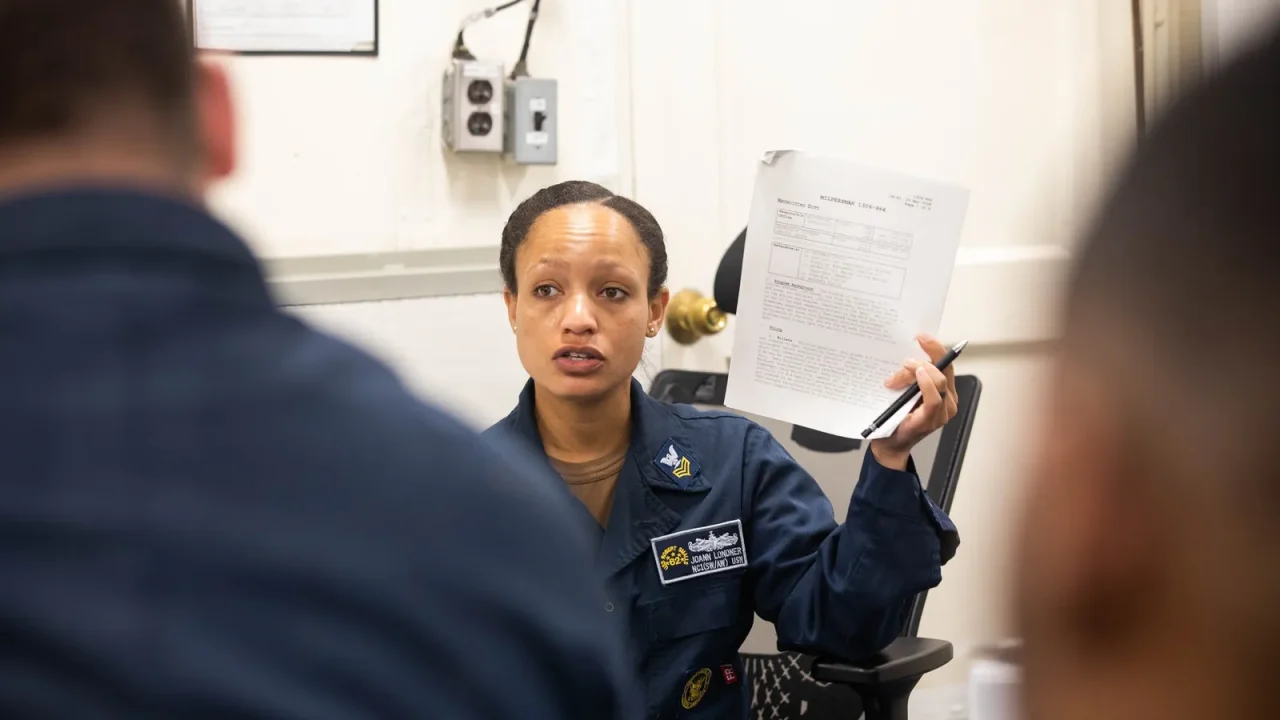
A Career Development Board is a scheduled sit-down between a sailor and their chain of command to talk about goals, qualifications and what comes next. Every sailor gets one within 60 days of reporting to a command, then at set points after that. Each board is recorded in the Navy’s career counselling system so there is proof it happened.
Done well, a Career Development Board, or CDB, is one of the most useful half-hours in a sailor’s year. Done badly, it is a box ticked and forgotten. The difference is almost always preparation and a proper record.
This guide explains when boards are due, who runs them, what should be covered and how to document them properly, whether you are the sailor in the chair or the leader running the board. It is based on the Navy’s own career counselling guidance. 📋
What is a Career Development Board?
A CDB is a formal meeting about you. It brings a sailor together with the leaders who can actually help: the career counselor, the chief, and often the senior enlisted leader.
The Navy’s guidance calls the first one, the reporting board, “the most critical interaction between the Sailor and immediate chain of command.” It gives the sailor a chance to say what they want, and it lets the command explain what it expects and what help is on offer.
A board is not a disciplinary hearing and it is not an inspection. Nobody is in trouble. It is a planning session.
What a board should cover
- Your goals: advancement, education, special programmes, a commission, or life after the Navy.
- Your qualifications: what you have earned and what is due next.
- Your timeline: when your contract ends and when you are due to rotate.
- Your options: reenlistment, a change of rating, the Reserve or separation.
- Your obstacles: anything in the way, from fitness to family needs.
- The command’s part: what your leaders will do to help.
A good board ends with a short list: what the sailor will do, what the chain of command will do, and by when.
When are boards due? The active-duty schedule
The schedule was simplified in recent years. Many sailors and even some leaders still quote the old one, with boards at 6 and 12 months. For most active-duty sailors, that is no longer the rule.
| Board | Held at | When |
|---|---|---|
| Reporting | Command level | Within 60 days of reporting |
| 24 month | Department | After 24 months on board, if you have 15 months or more left before you rotate or your contract ends |
| 48 month | Department | After 48 months on board, with the same condition |
| 60 month | Department | As required |
| C-WAY (reenlistment) | Command level | 15 months before your contract ends or your rotation date |
| Separation | Command level | For high year tenure, Fleet Reserve, retirement and other separations not covered by C-WAY |
Source: MyNavy HR, “CDB Schedule Changes” guidance and the Career Counselor Handbook, section 5.4.
A few details are worth knowing:
- A C-WAY board can replace the next scheduled one. If you had a command-level C-WAY board before your 24, 48 or 60-month board fell due, that scheduled board is not required.
- Biennial boards come later. After the 60-month board, the system moves to a board every two years for longer-serving sailors.
- Old boards may still show. If you completed 6, 12 or 18-month boards under the old schedule, they stay on your record.
What is C-WAY?
C-WAY stands for Career Waypoints. It is the Navy’s system for managing reenlistment and rating changes. Before you can reenlist, you generally need an approval through C-WAY. The C-WAY board, 15 months out, exists so that nobody reaches the end of a contract without having talked through the timeline, their intentions, incentives and options.
Different schedules for different sailors
Undesignated sailors (PACT)
Sailors in the Professional Apprenticeship Career Tracks programme have not yet been assigned a rating. They need more frequent boards, because choosing a rating is the biggest decision in front of them.
| Board | Held at | Purpose |
|---|---|---|
| Reporting | Command level | Within 60 days of reporting |
| 6 month | Department | Review the sailor’s rating opportunities |
| 12 month | Department | Review the sailor’s rating opportunities |
| 18 month | Command level | Only if the sailor has not yet been approved for a rating |
Once a PACT sailor is rated, the extra boards drop away and the normal schedule applies.
Reservists
| Board | Held at | When |
|---|---|---|
| Reporting | Command level | Within 4 drill weekends of reporting to the unit |
| 24, 48 and 60 month | Department | At those points on board; 60 month as required |
| C-WAY | Command level | 24 months before the end of obligated service |
| High year tenure | Command level | 24 months before the high year tenure date |
Note the difference. For reservists the C-WAY board is due 24 months out, not 15, because drilling time is so limited.
Optional boards
A board does not have to wait for the schedule. The command can direct one, or you can ask for one. The Navy’s guidance lists these reasons:
- Applying for a special programme
- A change of rating
- Advancement
- Officer programmes
- Extending an overseas tour
- Two or more fitness assessment failures in the past four years
Many sailors do not realise this. If you are thinking about a commissioning programme, a rating change or getting out, ask your career counselor for a CDB. It puts your goal on record and gets leaders involved early.
Who is in the room?
It depends on the level of the board.
| Level | Usually chaired by | Typically includes |
|---|---|---|
| Command | The command master chief, chief of the boat or senior enlisted leader, or someone they designate | The Command Career Counselor and the sailor’s departmental leadership |
| Department | Departmental leadership | The department leading chief, the department or division career counselor, and the sailor’s chief |
Behind the boards sits the command’s Career Development Team. It includes the commanding officer, the executive officer, the senior enlisted leader, the Command Career Counselor and departmental leaders. The team is expected to meet regularly to keep the whole programme on track.
How to document a Career Development Board
This is the part that gets skipped, and it is the part that matters most later. An undocumented board might as well not have happened. Inspectors look for the record, and so will your next command.
Where the record lives
CDBs are entered and verified in the Navy’s Career Information Management System, known as CIMS. Your career counselor has access. The system shows which boards are due for each sailor, and it marks a board complete once it has been entered and verified.
Documenting a board, step by step
- Check what is due. The career counselor pulls the list of boards due from the system each month.
- Prepare the sailor’s information. Gather the basics before the board: contract end date, rotation date, qualifications, evaluations, fitness results and education.
- Hold the board. Cover the sailor’s goals, timeline and options. Agree on actions.
- Write the minutes. Record who was there, what was discussed, the sailor’s stated intentions and each action with a name and a date.
- Enter it in the system. The career counselor records the board in CIMS.
- Verify it. A board only counts as complete once it has been verified.
- Give the sailor a copy. They should leave knowing exactly what was agreed.
- Follow up. Check the actions at the next board, or sooner.
What good minutes look like
| Weak entry | Strong entry |
|---|---|
| “Sailor wants to advance.” | “Sailor will complete the eligibility exam by 30 June. Chief to confirm the worksheet is correct by 15 July.” |
| “Discussed college.” | “Sailor to call the Navy College counselor this month and bring a degree plan to the division officer.” |
| “Undecided on reenlistment.” | “Contract ends in 16 months. C-WAY application to be submitted next month. Sailor wants orders to the West Coast.” |
| “No issues.” | “Sailor has a family member with medical needs. Referred to Fleet and Family Support. Chief to follow up in two weeks.” |
Board minutes are a career record, not a diary. Note that a referral was made, not the personal details behind it. Medical, legal and family specifics belong with the people qualified to handle them.
Keep your own copy
Records can go missing when sailors transfer. Keep a personal copy of every board in a folder with your evaluations, awards and qualifications. Many sailors call this their “I love me” binder. It is the first thing to reach for when you are getting ready for a selection board or writing an evaluation.
How to prepare, if you are the sailor
- Know your dates. When does your contract end? When are you due to rotate?
- Write down three goals. One for this year, one for this tour, one for your career.
- List what you need. A school, a qualification, time to study, a recommendation.
- Bring your questions. About reenlistment bonuses, programmes, orders or education.
- Be honest. If you are thinking of getting out, say so. Your leaders can only help with the plan you actually have.
- Take notes, and ask for a copy of the minutes.
Thinking about college? Read our guide to Navy Tuition Assistance before your board. Thinking about advancement? See how advancement works.
How to run a good board, if you are the leader
- Read the sailor’s record first. Do not learn their contract end date in front of them.
- Let the sailor talk. Ask what they want before you tell them what you think.
- Bring answers. Know the current bonus levels, programmes and deadlines for their rating.
- Agree real actions. Each with a name and a date.
- Treat “I am getting out” with respect. A sailor who leaves well may join the Reserve, come back, or recommend the Navy to others.
- Close the loop. A promise made at a board and forgotten does more harm than no board at all.
A new sailor decides very quickly whether a command cares about them. A reporting board held on time, with leaders who have clearly read their record, tells them it does. One held late, or rushed, tells them the opposite.
Real-life situations
1. You have been on board four months and never had a board
For active-duty sailors, the reporting board is due within 60 days. Ask your division career counselor or your chief. It may simply have been missed.
2. Your contract ends in a year and nobody has mentioned C-WAY
You are already past the 15-month mark. See your Command Career Counselor this week. Timelines for reenlistment approval are strict.
3. You are an undesignated sailor trying to pick a rating
Use your 6 and 12-month boards to ask which ratings are open to you and what each one needs. Our career explorer can help you compare.
4. You have decided to leave the Navy
Ask for a separation board. It should cover your transition timeline, the Reserve and your benefits. Our Navy transition timeline lays out the steps.
5. You are a new division career counselor
Start by pulling the list of boards due and overdue. Fix the overdue ones first. Then set a monthly routine so that nothing slips again.
Common mistakes (and the fix for each)
⚠️ Mistake: Holding the board but never recording it.
✅ Fix: Enter it in the system and verify it the same week.
⚠️ Mistake: Using the old 6 and 12-month schedule for everyone.
✅ Fix: Most active-duty sailors are now on reporting, 24, 48 and 60 months.
⚠️ Mistake: Vague minutes such as “discussed goals”.
✅ Fix: Write specific actions with a name and a date.
⚠️ Mistake: Turning the board into a lecture.
✅ Fix: The sailor should do most of the talking.
⚠️ Mistake: Missing the C-WAY window.
✅ Fix: Track contract end dates and hold the board 15 months out.
⚠️ Mistake: No follow-up.
✅ Fix: Review the last board’s actions at the start of the next one.
⚠️ Mistake: Relying on the command to keep your records.
✅ Fix: Keep your own copies.
Pro tips
- Put your key dates in your phone: contract end, rotation date and the 15-month mark.
- Ask for a board before big decisions, not after.
- Bring a one-page summary of your goals and questions.
- Leaders: block out a regular time each month for boards.
- Use the board to recognise people. Say what the sailor is doing well.
- Keep records for at least two years at the command and department level.
Helpful gear for keeping career records
Good boards run on good records. These three items help sailors and counselors keep theirs in order. We chose them by researching what each one does and who it suits. We have not tested them hands-on, and we list the trade-offs. Read how we choose products.
| Product | Best for | Key feature | Price level | Link |
|---|---|---|---|---|
| Best for your recordsSooez 13-Pocket Expanding File Folder | An organised “I love me” file | 13 labelled pockets, letter size | Budget | See on Amazon (opens in a new tab) |
| Best for leadersPetty Officer's Guide | Petty officers learning to lead and mentor | Written by petty officers for petty officers | Mid-range | See on Amazon (opens in a new tab) |
| Best referenceThe Bluejacket's Manual, 26th Edition | Junior sailors building general knowledge | The standard handbook for sailors | Mid-range | See on Amazon (opens in a new tab) |
Price level is a broad guide, not a live price. Scroll the table sideways on small screens.
Sooez 13-Pocket Expanding File Folder
Budget
An accordion-style folder with 13 tabbed pockets. Label one pocket each for evaluations, awards, qualifications, training certificates, board minutes and education. When a board or an evaluation comes round, everything you need is already sorted.
Ideal for: Any sailor who wants their career paperwork in one place.
- Expanding spine for more capacity
- Tabbed pockets for sorting
- Light and easy to carry
- Brand
- Sooez
- Pockets
- 13, with tabs
- Paper size
- Letter and A4
- Material
- Polypropylene
- Size
- about 13 x 9.5 inches
What we like
- Inexpensive
- Keeps documents in order
- Fits in a seabag
Trade-offs
- Not waterproof or fire resistant
- Plastic clasp can wear with heavy use
- No lock
Petty Officer's Guide
Mid-range
A professional handbook for Navy petty officers from the Naval Institute Press. The publisher describes it as written and edited by petty officers for petty officers. It is a useful companion for anyone who has just started sitting on boards and mentoring junior sailors.
Ideal for: New petty officers and division career counselors.
- Part of the Blue and Gold Professional Library
- Focused on leadership at the petty officer level
- Written by experienced sailors
- Authors
- Paul A. Kingsbury and Daniel M. Richard
- Publisher
- Naval Institute Press
- Format
- Hardcover
- Length
- 296 pages
- Published
- March 2022
What we like
- Aimed squarely at petty officers
- From a trusted publisher
- Useful across several pay grades
Trade-offs
- Hardcover price
- Policy details can change after printing
- Not a substitute for current instructions
The Bluejacket's Manual, 26th Edition
Mid-range
The long-standing handbook for enlisted sailors. It covers customs, ranks, ships and day-to-day Navy life. It is a good book to recommend to a junior sailor at a reporting board, and a handy refresher for anyone studying general Navy knowledge.
Ideal for: Junior sailors, and leaders who want one book to recommend.
- Covers customs, ranks and Navy basics
- Written for enlisted sailors
- Long-running standard reference
- Authors
- Thomas J. Cutler, Mark T. Hacala and Paul A. Kingsbury
- Publisher
- Naval Institute Press
- Edition
- 26th
- Length
- 712 pages
- Published
- April 2023
What we like
- Broad and readable
- Trusted publisher
- Useful through a whole career
Trade-offs
- A thick book to carry
- Policy can change after printing
- Not a substitute for official guidance
Not sure where your career is heading?
Compare ratings and paths before your next board.
Frequently asked questions
What is a Career Development Board in the Navy?
It is a scheduled meeting between a sailor and their chain of command to review the sailor’s goals, qualifications and career options, and to agree what each side will do next.
How often are Career Development Boards held?
For most active-duty sailors: within 60 days of reporting, then at 24, 48 and 60 months on board, plus a C-WAY board 15 months before the contract ends or the rotation date. Undesignated sailors also have boards at 6 and 12 months.
Where are Career Development Boards documented?
In the Navy’s Career Information Management System, known as CIMS. The career counselor enters the board and it must be verified to count as complete.
Who runs a Career Development Board?
Command-level boards are chaired by the command master chief, chief of the boat or senior enlisted leader, or someone they designate. The 24, 48 and 60-month boards are conducted by the department.
Can I request a Career Development Board?
Yes. Boards can be requested by the sailor or directed by the command, for reasons such as special programmes, a change of rating, advancement or officer programmes.
When is the reporting CDB due for reservists?
Within the first four drill weekends after reporting to the unit.
Your quick-reference checklist
- Reporting board: within 60 days (4 drill weekends for reservists).
- Then: 24, 48 and 60 months on board.
- C-WAY board: 15 months before your contract ends (24 for reservists).
- PACT sailors: extra boards at 6 and 12 months.
- Prepare: know your dates, goals and questions.
- Record: specific actions, each with a name and a date.
- Enter and verify the board in the system.
- Keep your own copy.
- Follow up at the next board.
A Career Development Board costs half an hour. A good one can change the direction of a career. Prepare for it, write it down, and hold everyone, including yourself, to what was agreed. 📋
Sources
Facts last checked against these sources: October 2026.
- MyNavy HR — CDB Schedule Changes: the current board schedules for active, reserve, PACT and new accession sailors, who conducts each board, and optional boards.
- NAVPERS 15878 — Career Counselor Handbook: the Navy’s handbook for the career development programme.
- MyNavy HR: career management policy and community information.
More like this
Keep reading

Navy Reading List 2026: All 30 Books on the CNO Professional Reading Program
All 30 books on the current CNO Professional Reading Program, with a one-line summary of each, the four groups explained,…

NAVADMIN 283/13 Explained: The Navy EOD Retention Bonus Then and Now
NAVADMIN 283/13 renewed a retention bonus for senior Navy EOD technicians in 2013. Here is what it said, what replaced…

Navy Tuition Assistance: How to Apply and What It Covers (2026)
How Navy Tuition Assistance works: who qualifies, how much it pays, the six steps to apply in MyNavy Education, the…