Navy Aircraft Crashes: What Happens After a Mishap and How the Navy Investigates
What happens after a Navy aircraft mishap: the five mishap classes, the first hours, the two separate investigations, why safety findings stay private, and what families can expect.
Some links on NavyMentor are affiliate links. If you buy through one, we may earn a commission at no extra cost to you. It never changes what we recommend. How this works
In this guide
When a Navy aircraft crashes, the Navy calls it a mishap, and a set process begins at once. Crews are rescued or recovered, families are told before any names are made public, and a board of investigators starts work to find out what happened so that it does not happen again.
If you are reading this because of something in the news, it can be hard to tell what is known from what is rumour. Early reports are often wrong, and the Navy says very little in the first days. There are good reasons for that.
This guide explains how the Navy classifies an aircraft mishap, who investigates and why most of the findings stay private, what families can expect, and how to find reliable information. It is based on the Naval Safety Command’s own published guidance.
Why the Navy says “mishap”
You will rarely see the Navy use the word “accident”. It uses mishap.
The choice is deliberate. “Accident” suggests something that could not have been prevented. Naval aviation works from the opposite belief: that nearly every mishap has causes that can be found and fixed. The whole system that follows a crash is built on that idea.
A mishap also covers far more than a crash. A hard landing, an engine damaged by a loose tool, or an injury on the flight deck can all be mishaps.
The five mishap classes
The Navy grades every mishap by how much damage was done and how badly people were hurt. The Naval Safety Command publishes the definitions.
| Class | Property damage | Injury |
|---|---|---|
| A | $2,500,000 or more, or an aircraft destroyed | A death or a permanent total disability |
| B | $600,000 or more, but less than $2,500,000 | A permanent partial disability, or three or more people admitted to hospital |
| C | $60,000 or more, but less than $600,000 | A non-fatal injury that causes time off work beyond the day it happened |
| D | $25,000 or more, but less than $60,000 | A recordable injury or illness not covered by A, B or C |
| E | Less than $25,000 | Injury or damage not covered by the classes above |
Source: Naval Safety Command, “Current Mishap Definitions”. The cost thresholds have applied since 1 October 2019.
A mishap is placed in the highest class it qualifies for. An aircraft that is badly damaged with nobody hurt can still be Class A on cost alone. Modern aircraft are so expensive that even damage which looks minor can cross the threshold.
A “Class A mishap” in a headline does not always mean a crash, and it does not always mean someone died. It means the event met the most serious threshold for cost or injury.
How often does it happen?
The Naval Safety Command publishes mishap statistics for the public. Its summary for the fiscal year that ended on 30 September 2026 shows 16 Class A aviation mishaps on its headline chart, which counts crewed and uncrewed aircraft together. That is a rate of 2.23 for every 100,000 flight hours. The year before, the figures were 12 and 1.60. The ten-year average was about 11 a year.
Numbers like these move up and down from year to year, and a single year proves little. What matters to the people who study them is the long-term trend and the causes behind each event.
The first hours after a crash
Before any investigation begins, there are more urgent jobs.
- Rescue. Search and rescue starts immediately. At sea, that often means a helicopter and nearby ships. Ashore, it involves local emergency services as well.
- Making the scene safe. A crash site can be dangerous long after the event. There may be fuel, ammunition, ejection seat charges and sharp carbon fibre debris.
- Protecting the evidence. Wreckage, recordings and maintenance records are secured so that investigators see them untouched.
- Telling the families. If anyone has been killed, seriously hurt or is missing, the Navy notifies their next of kin in person wherever it can.
- A first public statement. The Navy confirms that a mishap has happened. It usually gives the type of aircraft and the general location, and little else.
Why names are held back
The Department of Defense does not release the names of those killed until after their families have been told, and it normally waits a further 24 hours. The aim is simple. Nobody should learn of a death from a news site or a social media post.
This is why early reports say “a pilot” or “two crew members” and nothing more. It is not secrecy for its own sake. It is the Navy keeping a promise to its families.
If you hear who was involved before the Navy announces it, keep it to yourself. Posting a name, a squadron or a photo can reach a family before the official knock on the door. That harm cannot be undone.
Two investigations, two different jobs
This is the part that confuses people most. A serious mishap can lead to two separate investigations, run by different people for different reasons.
| Safety investigation | Command or legal investigation | |
|---|---|---|
| Purpose | To find the causes and prevent the next mishap | To establish the facts and decide questions of responsibility |
| Run by | A board of trained officers, such as an Aviation Mishap Board | An investigating officer appointed by the chain of command |
| Used for discipline? | No | It can be |
| Witness statements | Given in confidence | Not confidential in the same way |
| Released to the public? | Normally not | Often available on request, with private details removed |
The two are kept apart on purpose. Each one works because the other exists.
The safety investigation
For aircraft, the safety investigation is carried out by an Aviation Mishap Board. Other kinds of serious mishap get a Safety Investigation Board.
The Naval Safety Command describes the task plainly. Boards are convened to determine the causal factors and to make internal recommendations to Navy and Marine Corps leaders, so that similar mishaps can be prevented.
When a formal board is required
Navy and Marine Corps policy requires a formal board for, among other things:
- all on-duty Class A mishaps, on or off base;
- cases where damage to Department of Defense property is expected to exceed $2,500,000;
- an on-duty injury where death or permanent total disability is likely;
- Class A explosives mishaps.
Who sits on the board
Board members are officers and specialists, usually with experience of the aircraft involved. Investigators from the Naval Safety Command do not sit on the board. They act as expert advisers to it and help it follow the proper process.
Why the findings stay private
People often assume a report is being hidden. In fact the confidentiality is the reason the system works.
Safety investigators need the truth, quickly. A pilot or a maintainer is far more likely to say “I made a mistake” if they know their words cannot be used to punish them. So what witnesses tell a safety board is protected. The Naval Safety Command calls this privileged safety information.
That protection is recognised by the courts. Because of it, the Naval Safety Command says investigation reports and findings are not typically released to the public. The commander of the Naval Safety Command is the Department of the Navy’s only authority for releasing privileged safety information.
The findings go to the people who can act on them: squadrons flying the same aircraft, maintainers, trainers and the engineers who design the equipment. A lesson learned from one mishap can change procedures across the fleet within days.
The command or legal investigation
Alongside the safety board, the chain of command may order its own investigation. It is often called a JAGMAN investigation, after the legal manual that governs it.
This one gathers facts for different purposes. It can be used to settle claims, to decide whether an injury or death happened in the line of duty, and to decide whether anyone should be held to account.
Because it is not built on confidential safety statements, this is the investigation that members of the public and the press can usually ask to see, through a Freedom of Information Act request. Private and sensitive details are removed first, and the process can take a long time.
What investigators look for
No two mishaps are the same, but investigators work through the same broad questions each time.
| Area | Questions asked |
|---|---|
| People | Training, rest, workload, decisions, communication and supervision |
| Machine | Design, parts, maintenance history and any known faults |
| Environment | Weather, sea state, light, terrain and the ship’s motion |
| Mission | The plan, the risks accepted and the pressure to get the job done |
| Organisation | Procedures, staffing, culture and whether earlier warnings were missed |
It is rare for a mishap to have a single cause. Usually several things line up: a tired crew, a small mechanical fault and bad weather, for example. Take away any one and the mishap might not have happened. That is why investigations look so widely.
How the Navy tries to prevent mishaps
Flying from ships is among the most demanding things any military does. Our guide to US aircraft carriers explains how much has to go right on every launch and landing. A great deal of effort goes into keeping it safe.
- Standard procedures. Every aircraft type has a detailed manual for how it must be flown and what to do in an emergency.
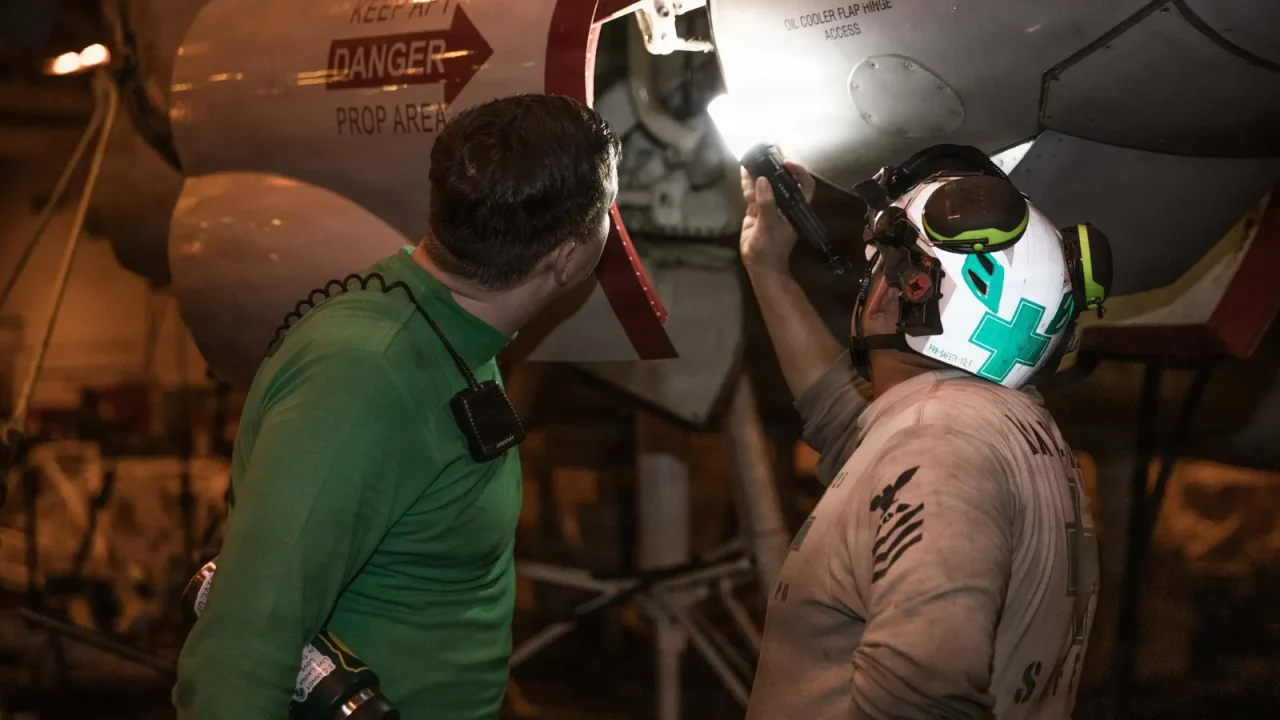
- Inspections and maintenance. Aircraft are checked before and after every flight and at set intervals. The photo at the top of this guide shows sailors inspecting landing gear in a carrier’s hangar bay.
- Risk management. Crews are taught to identify hazards before a flight and decide how to reduce them.
- Reporting near-misses. Sailors are encouraged to report hazards and close calls, including anonymously, so that problems are fixed before anyone is hurt.
- Safety stand-downs. After a serious mishap, or a run of them, units may stop flying for a day to review procedures.
- Sharing lessons. The Naval Safety Command publishes statistics, summaries and lessons learned.
What families can expect
If a sailor is killed, seriously injured or missing, the Navy assigns the family a Casualty Assistance Calls Officer, often shortened to CACO. This is a uniformed officer or senior enlisted leader whose only job is to help that family.
- They deliver the news in person wherever possible.
- They stay with the family through the days and weeks that follow.
- They explain benefits and entitlements and help with the paperwork.
- They help with funeral and memorial arrangements and with travel.
- They are the family’s link to the Navy for questions about the investigation.
Other support is available too. The Navy-Marine Corps Relief Society can help with urgent costs. Fleet and Family Support Centers and chaplains offer counselling. Our guide to military service organizations lists more places to turn.
A mishap affects shipmates, friends and families far beyond those directly involved. If you need to talk to someone now, dial 988 and press 1 for the Military and Veterans Crisis Line. It is free and confidential, at any hour.
How to find reliable information
| Source | What you will find | How reliable |
|---|---|---|
| Official Navy statements | Confirmed facts, released when the Navy is sure of them | High, but brief and slow |
| Naval Safety Command statistics | Counts and rates of mishaps by class | High, but no details of single events |
| Established news outlets | Reporting based on named officials | Usually good; check the date |
| A released command investigation | A detailed account, months or years later | High, with parts removed |
| Social media and forums | Rumour, guesses and old footage | Low |
You will find the official sites in our master Navy links list.
If you see a military aircraft go down
- Call 911. Give the location as exactly as you can.
- Keep well away. Wreckage can burn, explode or give off harmful dust and fumes.
- Do not touch or take anything. Debris is evidence, and it may be dangerous.
- Tell the authorities what you saw. Your account may help investigators.
- Think before you post. Avoid sharing images that show crew members or identifying marks until the Navy has spoken.
Real-life situations
1. A crash is in the news and your sailor is at sea
The Navy contacts families directly and quickly when someone is hurt. If you have not heard anything, that is good news. Do not rely on social media, and do not call the ship. Your command’s ombudsman is the right person to ask.
2. You are a sailor and your squadron has had a mishap
Tell the safety board the truth. What you say to it is protected, and it may save a life. Look after each other, and use the chaplain or counsellors if you need them.
3. You want to know what caused a particular crash
The safety report will not be released. A command investigation may be, in time. Search for official statements first, then news reports that cite the released investigation.
4. You are worried about your child joining naval aviation
The concern is natural. It may help to know how much effort goes into safety, and that the great majority of flights end without incident. Talk it through together.
5. You are writing about a mishap for school or work
Use the official mishap classes, cite the Navy’s own statements, and be clear about what is confirmed and what is not.
Common mistakes (and the fix for each)
⚠️ Mistake: Believing the first reports.
✅ Fix: Early details are often wrong. Wait for an official statement.
⚠️ Mistake: Assuming “Class A” means a fatal crash.
✅ Fix: It can also mean costly damage with nobody hurt.
⚠️ Mistake: Thinking a private safety report is a cover-up.
✅ Fix: Confidentiality is what gets investigators honest answers.
⚠️ Mistake: Sharing a name before it is announced.
✅ Fix: Families must hear it from the Navy first.
⚠️ Mistake: Blaming the pilot straight away.
✅ Fix: Mishaps almost always have several causes.
⚠️ Mistake: Picking up debris as a souvenir.
✅ Fix: Leave it alone. It is evidence and may be hazardous.
Understanding naval aviation better
If you want to understand how flying from ships works, and why it carries the risks it does, these three books are a good place to start. We chose them by researching what each one covers and who it suits, and we list the trade-offs. Read how we choose products.
| Product | Best for | Key feature | Price level | Link |
|---|---|---|---|---|
| Best explainerUS Super Carrier Operations Manual | How flight operations at sea actually work | Large-format photos and diagrams | Mid-range | See on Amazon (opens in a new tab) |
| Best on aircraft designSkunk Works | How advanced aircraft are built and tested | A first-hand memoir from Lockheed | Budget | See on Amazon (opens in a new tab) |
| Best historyWorld Encyclopedia of Aircraft Carriers | How carrier aviation developed | An illustrated history of carriers worldwide | Mid-range | See on Amazon (opens in a new tab) |
Price level is a broad guide, not a live price. Scroll the table sideways on small screens.
US Super Carrier: Operations Manual
Mid-range
A large-format hardcover that explains how American supercarriers are designed and run, including how aircraft are launched and recovered. It gives a clear picture of why carrier flying is so demanding and how many people it takes to do it safely.
Ideal for: Readers who want to understand what happens on a flight deck.
- Covers design, departments and flight operations
- Sections on daily life aboard
- Photos and diagrams throughout
- Authors
- Chris McNab and Patrick Bunce
- Format
- Hardcover
- Length
- 188 pages
- Published
- August 2020
- Page size
- 11 x 8.5 inches
What we like
- Clear and visual
- Explains the whole system
- Suitable for non-specialists
Trade-offs
- Published in 2020, so recent changes are missing
- Stock can run low
- Not a book about safety as such
Skunk Works: A Personal Memoir of My Years at Lockheed
Budget
Ben Rich ran Lockheed’s famous advanced projects workshop. His memoir describes how aircraft such as the F-117 were designed, tested and made to work, including the setbacks along the way. It is on the Navy’s current professional reading list.
Ideal for: Anyone curious about the engineering and testing behind military aircraft.
- A first-hand account
- On the CNO Professional Reading Program
- Covers design, testing and risk
- Author
- Ben R. Rich
- Format
- Paperback
- Length
- 372 pages
- Publisher
- Little, Brown
- This edition
- February 1996
What we like
- Readable and engaging
- Honest about failures
- Inexpensive paperback
Trade-offs
- About Air Force and CIA aircraft more than Navy ones
- First published in the 1990s
- Light on technical detail
World Encyclopedia of Aircraft Carriers
Mid-range
A big illustrated history of aircraft carriers, from the earliest experiments to modern nuclear-powered ships. It shows how the dangers of flying at sea were tackled over a century, through changes such as the angled deck and better landing aids.
Ideal for: History readers who want the long view.
- Covers carriers from many navies
- Heavily illustrated
- Updated edition
- Authors
- Bernard Ireland and Francis Crosby
- Format
- Hardcover
- Length
- 288 pages
- Published
- December 2023
- Page size
- about 9 x 11.4 inches
What we like
- Wide coverage in one volume
- Good for browsing
- Recently updated
Trade-offs
- A large, heavy book
- Broad rather than deep
- The newest events will be missing
Frequently asked questions
What is a Class A mishap in the Navy?
A Class A mishap is the most serious category. It involves a death or permanent total disability, a destroyed aircraft, or property damage of 2.5 million dollars or more.
Who investigates a Navy aircraft crash?
An Aviation Mishap Board carries out the safety investigation, advised by investigators from the Naval Safety Command. The chain of command may also order a separate command or legal investigation.
Are Navy mishap investigation reports made public?
Safety investigation reports are normally not released, because they contain privileged safety information. A separate command investigation can often be requested under the Freedom of Information Act, with private details removed.
Why does the Navy not release names straight away?
The Department of Defense does not release the names of those killed until their next of kin have been notified, and it normally waits a further 24 hours.
Why does the Navy say mishap and not accident?
Because naval aviation works on the principle that mishaps have causes that can be identified and prevented, which the word accident does not convey.
Who helps the family after a Navy mishap?
A Casualty Assistance Calls Officer is assigned to the family to deliver the news, explain benefits, help with arrangements and act as their link to the Navy.
Your quick-reference checklist
- Mishap classes run from A to E. Class A is the most serious.
- Class A: a death, a permanent total disability, a destroyed aircraft or $2.5 million in damage.
- Two investigations: one for safety, one for facts and responsibility.
- Safety findings stay private so that people speak honestly.
- Names are released only after families are told.
- Trust official statements over social media.
- Never share names or guesses.
- If you witness a crash: call 911 and keep away.
Behind every mishap report are real people: the crew, their families and the shipmates who carry on flying. The Navy’s process is slow and quiet by design. It exists to look after those people, and to make sure that whatever went wrong is not repeated.
Sources
Facts last checked against these sources: October 2026.
- Naval Safety Command — Current Mishap Definitions: the five mishap classes and their thresholds.
- Naval Safety Command — Mishap Investigations: the purpose of safety boards, when they are required and why findings are privileged.
- Naval Safety Command — Statistics: public mishap statistics, including the fiscal year 2026 summary.
- MyNavy HR — Casualty Assistance: the Navy’s casualty support for families.
More like this
Keep reading
USS North Dakota (SSN-784): Christening, Key Facts and the Submarine Today
The submarine USS North Dakota (SSN-784) was christened on 2 November 2013. Here are the key facts, what its Block…
USS Gerald R. Ford (CVN-78): Christening, Key Facts and Where It Is Now
The aircraft carrier Gerald R. Ford (CVN-78) was christened on 9 November 2013. Here is what happened that day, what…
Does Mexico Have an Aircraft Carrier? The Mexican Navy Explained
No. Mexico has never had an aircraft carrier. Here is what ships the Mexican Navy really has, why a carrier…