NFAAS: How to Update and Verify Your Contact Info (2026 Deadline)
How to update and verify your NFAAS contact information step by step. Who has to do it, the 16 October 2026 deadline, the details people get wrong, and what happens when a real disaster hits.
Some links on NavyMentor are affiliate links. If you buy through one, we may earn a commission at no extra cost to you. It never changes what we recommend. How this works
In this guide
To update or verify your NFAAS contact information, sign in at navyfamily.navy.mil, open the “My Info” tab, check your contact details and your family’s details, and confirm they are current. The Navy requires this twice a year. The current deadline is 16 October 2026.
It takes about ten minutes. And it matters more than most routine admin, because NFAAS is how the Navy finds you and your family after a hurricane, earthquake, wildfire or other disaster.
This guide walks you through every step, explains who has to do it, and shows you what happens when a real emergency hits. Everything here comes from the Navy’s own message on the subject. 🌀
What is NFAAS?
NFAAS stands for the Navy Family Accountability and Assessment System. The name tells you its two jobs.
- Accountability. After a disaster, the Navy needs to know quickly that every sailor, civilian and family member in the affected area is safe. NFAAS is the system it uses to do that.
- Assessment. Once people are accounted for, families can use the same system to tell the Navy what help they need.
In the Navy’s own words, NFAAS is the system used to account for personnel and their families during widespread natural or man-made disasters. It only works if the contact details in it are right. That is why the Navy orders everyone to check them twice a year.
NFAAS is a bit like a smoke alarm. You hope you never need it, but it is useless if the battery is flat.
Who has to update NFAAS?
The rules are different for different groups. The table shows what the current message says.
| Who | Your own details | Your dependents’ details |
|---|---|---|
| Uniformed personnel, active and reserve | Mandatory | Mandatory |
| Contractors based outside the continental United States | Mandatory | Mandatory |
| Navy civilians not in a bargaining unit | Mandatory | Voluntary, but strongly encouraged |
| Navy civilians in a bargaining unit | Strongly encouraged | Strongly encouraged |
Source: NAVADMIN 210/26, paragraph 2.
If you are a sailor, the short version is simple. You must do it, and you must include your family.
When is it due?
The requirement comes round twice a year. Each time, the Navy releases a NAVADMIN with the exact deadline.
| Cycle | Message | Deadline |
|---|---|---|
| Spring 2026 | NAVADMIN 092/26 (April 2026) | Mid-May 2026 |
| Autumn 2026 | NAVADMIN 210/26 (15 September 2026) | 16 October 2026 |
You do not have to wait for the deadline. For the autumn 2026 cycle, a record updated at any point between 31 March 2026 and 16 October 2026 is treated as valid.
Older messages used 1 April and 1 October as the checkpoints. Recent ones have set their own dates. Always read the current message rather than relying on memory.
Other times you must update
The twice-yearly check is only the minimum. You are also expected to update NFAAS:
- Whenever your address or contact details change for good, such as after a move.
- When you check in to a new command.
- When you check out of your old one.
The Navy tells every command to make this a standard part of check-in and check-out.
How to update NFAAS: step by step
Have your family’s details ready before you start: addresses, phone numbers and the name of your mobile phone carrier.
- Go to the NFAAS website. The address is navyfamily.navy.mil.
- Sign in. Use one of the sign-in options shown on the login page.
- Open the “My Info” tab. This is where your record lives.
- Check “Contact Information”. Review your address, phone numbers and email. Also check your work location details.
- Check “Family Member Info”. Review each family member’s details and edit anything that is out of date.
- Check “Emergency Contacts”. You will find this on the left-hand panel under “My Info”. You should have at least one person listed.
- Verify as current. Even if nothing has changed, you still need to confirm that the details are correct. That is what updates the date on your record.
Four details people get wrong
| Detail | What the Navy requires | Why it matters |
|---|---|---|
| Address | Your physical address. PO boxes and APO or FPO addresses are not allowed. | The Navy needs to know where you actually live to tell whether a disaster affects you. |
| Mobile carrier | You must choose your carrier from the drop-down list. | It is needed to send you alerts by text. |
| Main phone number | List your personal mobile number as your primary contact. | That is the phone you will have with you in an evacuation. |
| Exceptional Family Member Program | Any family member enrolled in the program must be marked as such. | It tells responders that someone may need extra support. |
Source: NAVADMIN 210/26, paragraph 5.
The message also asks sponsors to look at their DEERS data while updating NFAAS, and to correct it if needed. DEERS is the database that controls your family’s military benefits, so it is worth the extra minute.
What happens in a real disaster
When a major event threatens or hits an area with Navy people in it, the Navy can issue an order to account. From that point, everyone in the affected area has to check in, or “muster”.
- The order goes out. It names the area affected and who must check in.
- You check in. You can do this through your command, or by signing in to NFAAS and reporting your status and your family’s.
- Your command tracks the numbers. Each command has representatives who can see who has and has not checked in.
- You report what you need. If your family has been affected, you can complete a needs assessment in NFAAS.
- Support follows. The information helps the Navy direct help to the families who need it.
The Navy practises this. In 2026 it ran accountability exercises alongside its hurricane drills, with messages clearly marked as exercises.
If you cannot get online
Power and internet often fail in a disaster. If you cannot reach NFAAS, contact your command’s representative, your mustering point of contact or your supervisor. If you cannot reach any of them, the MyNavy Career Center is a fallback on 1-833-330-MNCC (1-833-330-6622).
If you are deployed when a storm hits home, your spouse may be the one who needs to check in. Make sure they know NFAAS exists, where it is and who to call at your command. Write the numbers down on paper.
What your command does
NFAAS is not just a job for individuals. Commands have their own duties.
- 100 percent compliance. Commanding officers must make sure everyone who is required to update has done so.
- A named representative. Each command should have at least one commanding officer’s representative, often called a COR, assigned in NFAAS.
- A status report. Representatives can run a report by unit that shows the date each person last updated their details.
- Check-in and check-out. Reviewing NFAAS should be a routine step when people arrive and leave.
That report is how your chain of command knows whether you have done it. If your name is on the overdue list, expect a reminder.
NFAAS help
| Problem | Who to contact |
|---|---|
| You cannot sign in or the site has a technical fault | The NFAAS Help Desk. NAVADMIN 210/26 lists [email protected] and [email protected]. |
| You are not showing under the right command | Your command’s representative, who can move your record to the correct unit |
| You do not know who your representative is | Your admin office or your chain of command |
| You need to check in during a disaster and cannot get online | Your command, your mustering point of contact, or the MyNavy Career Center |
Build your family’s emergency plan while you are at it
Updating NFAAS is a good prompt to check the rest of your readiness. The federal government’s Ready campaign suggests a few basics for every household.
- A plan. Where will you meet? Who will you call? How will you get out?
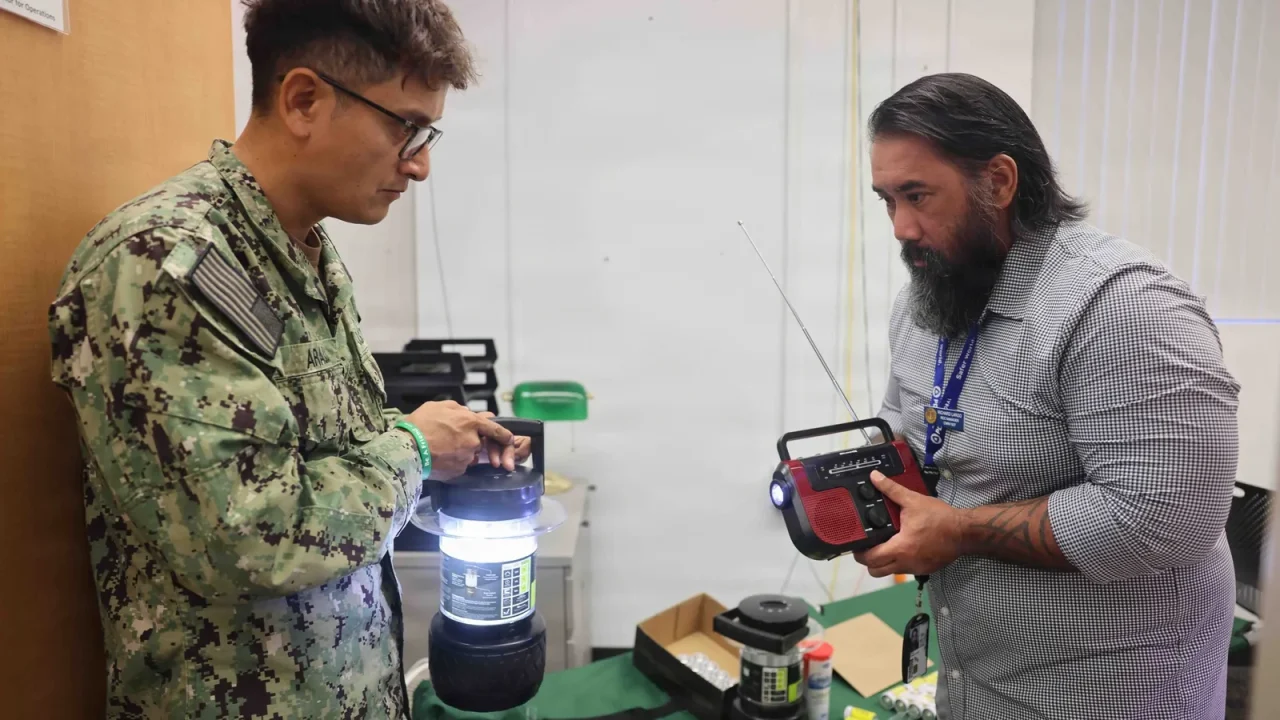
- A kit. Water, food that keeps, a radio, a torch, a first aid kit, spare batteries and any medicines you need.
- Your documents. Copies of IDs, orders, insurance policies and medical records, kept somewhere safe and easy to grab.
- A way to stay informed. A battery or hand-crank radio works when phones do not.
Our packing checklists can help you think through what to keep ready.
NFAAS, DEERS and NSIPS: which record is which?
Sailors often assume that changing an address in one Navy system changes it everywhere. It does not. These three systems hold similar details but do different jobs, and each one has to be updated separately.
| System | What it is for | Why your address matters there |
|---|---|---|
| NFAAS | Finding and helping people after a disaster | It tells the Navy whether you are in the affected area |
| DEERS | Eligibility for military benefits, including health care | It affects your family’s coverage and ID cards |
| NSIPS | Your Navy personnel record | It is the address of record for your career paperwork |
A good habit is to treat a move as a three-system job. Update NSIPS through your admin office, check DEERS, then sign in to NFAAS. Do all three on the same day and you will not have to think about it again until the next cycle.
A note for spouses and family members
You are part of this system too. If the sailor in your family is at sea or deployed when something happens at home, you may be the one the Navy is trying to reach. Ask them to show you their NFAAS record, check that your mobile number and address are right, and keep the name and number of their command’s point of contact somewhere you can find it without a phone signal or power.
Real-life situations
1. Nothing has changed since last time
You still need to sign in and verify. The system records the date you last confirmed your details, and that date is what your command checks.
2. You just moved
Update NFAAS straight away, without waiting for the next cycle. Use your new physical address, not a PO box.
3. You are deployed
Update before you leave, and make sure your family’s details and your emergency contact are right. They are the ones who may need to be found.
4. You are a reservist
The requirement covers reserve personnel too. Do it from home or at your next drill weekend.
5. A hurricane is forecast for your area
Check that your details are current, charge your phone, and watch for an order to account. If you evacuate, check in as soon as you safely can.
Common mistakes (and the fix for each)
⚠️ Mistake: Entering a PO box or FPO address.
✅ Fix: Use the physical address where you actually live.
⚠️ Mistake: Skipping the mobile carrier field.
✅ Fix: Pick your carrier from the list so that alerts can reach you.
⚠️ Mistake: Updating yourself but not your family.
✅ Fix: For sailors, dependents’ details are mandatory too.
⚠️ Mistake: Using a work phone as your main number.
✅ Fix: List your personal mobile as the primary contact.
⚠️ Mistake: Leaving the emergency contact blank.
✅ Fix: Add at least one person who would know where you are.
⚠️ Mistake: Leaving it to the last day.
✅ Fix: Do it early. Sites slow down when everyone signs in at once.
⚠️ Mistake: Assuming a move updated everything automatically.
✅ Fix: NFAAS is separate. Update it yourself after every move.
Pro tips
- Put two reminders in your calendar, one in March and one in September.
- Do it on the same day as other admin, such as checking your record and your pay statement.
- Take a screenshot when you finish, in case anyone asks.
- Show your spouse how to sign in. Do not leave it as something only you know.
- Keep key phone numbers on paper in your emergency kit.
- Look for the next NAVADMIN each spring and autumn for the exact deadline.
You can find NFAAS and other official sites in our master Navy links list.
Emergency gear worth having at home
NFAAS helps the Navy find you. These three items help your family cope in the first few days of an emergency. We chose them by researching what each one does and who it suits. We have not tested them hands-on, and we list the trade-offs. Read how we choose products.
| Product | Best for | Key feature | Price level | Link |
|---|---|---|---|---|
| Best for staying informedMidland ER310 Emergency Crank Weather Radio | News and weather when the power is out | Hand crank, solar and USB charging | Mid-range | See on Amazon (opens in a new tab) |
| Best ready-made kitReady America 2-Person 3-Day Emergency Kit | A grab-and-go bag for two people | Food, water and first aid in a backpack | Mid-range | See on Amazon (opens in a new tab) |
| Best for documentsSentrySafe Fire-Resistant Chest | Protecting papers you would need afterwards | Fire tested, with a key lock | Mid-range | See on Amazon (opens in a new tab) |
Price level is a broad guide, not a live price. Scroll the table sideways on small screens.
Midland ER310 Emergency Crank Weather Radio
Mid-range
A portable AM/FM and weather radio that you can power by turning a crank, by its solar panel or over USB. It has a built-in torch. When mobile networks and power fail, a radio like this is often the only way to hear official instructions.
Ideal for: Any household in a hurricane, wildfire or earthquake area.
- Built-in torch
- Several ways to recharge
- Compact enough for a go-bag
- Brand
- Midland
- Model
- ER310
- Power
- Hand crank, solar and USB
- Bands
- AM, FM and weather
- Size
- about 9.6 x 3 x 6.9 inches
What we like
- Works without mains power
- From an established radio maker
- Simple to use
Trade-offs
- Cranking by hand gives limited listening time
- Costs more than basic radios
- The solar panel charges slowly
Ready America 70280 2-Person 3-Day Emergency Kit
Mid-range
A backpack packed with the basics for two people for three days. The listing includes food bars totalling 4,800 calories, 12 water pouches, two ponchos, two survival blankets, a 33-piece first aid kit, light sticks and a whistle. The food and water are listed with a five-year shelf life.
Ideal for: Families who want a starting point they can add to.
- Food and water with a five-year shelf life
- 33-piece first aid kit
- Ponchos, blankets, light sticks and a whistle
- Brand
- Ready America
- Model
- 70280
- Covers
- 2 people for 3 days
- Weight
- about 7.8 lb
- Bag size
- about 9.5 x 6 x 12 inches
What we like
- Everything in one bag
- Light enough to carry
- Saves you building a kit from scratch
Trade-offs
- Covers the basics only, so add medicines and documents
- Food bars are for emergencies, not comfort
- You must check and replace items as they expire
SentrySafe Fire-Resistant Chest (0.25 cubic feet)
Mid-range
A small fire-resistant chest for the papers that are hardest to replace: birth certificates, passports, wills, powers of attorney and insurance policies. The listing says it is UL classified for half an hour of fire endurance at 1,550°F.
Ideal for: Keeping originals safe at home and easy to grab in an evacuation.
- Fire-resistant construction
- Privacy key lock
- Carrying grips
- Brand
- SentrySafe
- Capacity
- 0.25 cubic feet
- Lock
- Key
- Fire rating in the listing
- UL classified, 30 minutes at 1,550°F
- Size
- about 15.3 x 12.1 x 6.3 inches
What we like
- From an established safe maker
- Stated, tested fire rating
- Small and portable
Trade-offs
- A privacy lock, not theft protection
- Limited space for bulky items
- Not rated for flooding in this listing
One list for every official Navy site
Pay, records, health, family support and more, all in one place.
Frequently asked questions
What does NFAAS stand for?
NFAAS stands for the Navy Family Accountability and Assessment System. The Navy uses it to account for personnel and their families during widespread disasters and to find out what help they need.
How often do I have to update NFAAS?
Twice a year, by the deadline in the current NAVADMIN. You must also update it whenever your address or contact details change permanently, and when you check in to or out of a command.
What is the NFAAS deadline for autumn 2026?
Under NAVADMIN 210/26, the deadline is 16 October 2026. A record updated between 31 March 2026 and 16 October 2026 counts for this cycle.
Do I need to update NFAAS if nothing has changed?
Yes. You still need to sign in and verify that your details are current. That refreshes the date your command sees.
Can I use an FPO or PO box address in NFAAS?
No. The Navy requires your physical address. PO, APO and FPO addresses are not allowed.
Do family members have to be in NFAAS?
For uniformed personnel, yes. Updating and verifying the details of all categories of dependents is mandatory.
Your quick-reference checklist
- Go to navyfamily.navy.mil and sign in.
- Open “My Info”.
- Contact Information: physical address, personal mobile, carrier selected.
- Family Member Info: every dependent checked.
- Emergency Contacts: at least one person listed.
- Mark any family member in the Exceptional Family Member Program.
- Verify as current, even if nothing changed.
- Glance at DEERS and fix anything wrong.
- Autumn 2026 deadline: 16 October 2026.
- Tell your family how to check in if you are away.
Ten minutes, twice a year. It is one of the smallest jobs on your list, and one of the few that could really matter on the worst day your family ever has. Get it done, then get on with your week. 🌀
Sources
Facts last checked against these sources: October 2026.
- NAVADMIN 210/26 (15 September 2026): the order to update NFAAS personal contact information, with the deadline, who it applies to and the steps.
- MyNavy HR — NAVADMIN 2026 index: the list of 2026 messages, including NAVADMIN 092/26 and the NFAAS accountability exercises.
- Ready.gov — Build a Kit: the federal government’s guidance on household emergency supplies.
More like this
Keep reading
Navy Boot Camp Packing List: What to Bring and What to Leave at Home
The official Recruit Training Command list in plain English — required documents, permitted items, and everything that gets boxed up…
Life on a Navy Ship: What Daily Life Underway Is Really Like
Berthing, watches, food, connectivity and downtime — an honest picture of shipboard life and how to make it easier on…