USS North Dakota (SSN-784): Christening, Key Facts and the Submarine Today
The submarine USS North Dakota (SSN-784) was christened on 2 November 2013. Here are the key facts, what its Block III design changed, and what the boat has done since.
Some links on NavyMentor are affiliate links. If you buy through one, we may earn a commission at no extra cost to you. It never changes what we recommend. How this works
In this guide
The submarine North Dakota (SSN-784) was christened on 2 November 2013 at the Electric Boat shipyard in Groton, Connecticut. Its sponsor, Katie Fowler, broke the traditional bottle across the hull. The boat was commissioned a year later, on 25 October 2014, and it is still in service today.
North Dakota is a Virginia-class attack submarine. It was also the first boat of an improved version of that class, with a redesigned bow that changed how every later boat was built.
This guide covers the christening, the submarine’s key facts, what makes it different, what it has done since, and where it is now. It is written in plain English, with no engineering degree needed. 🌊
What happened at the christening
The ceremony took place on 2 November 2013 at General Dynamics Electric Boat in Groton, Connecticut. Electric Boat has been building submarines for the U.S. Navy for more than a century.
The honour of naming the boat went to its sponsor, Katie Fowler. She is the wife of Vice Admiral Jeff Fowler. Following a long Navy tradition, she broke a bottle against the submarine and gave it its name.
By then the submarine was nearly complete. It had been floated for the first time about seven weeks earlier, on 15 September 2013.
Not yet “USS”
On christening day the boat was not yet USS North Dakota. A Navy vessel only takes the title USS when it is commissioned. Before that it is a Pre-Commissioning Unit, or PCU. North Dakota became USS on 25 October 2014.
Submariners call their vessel a boat, however large it is. It is a tradition from the days when submarines really were small. You will see both words in this guide, and both are fine.
The road from contract to commissioning
A submarine passes several milestones before it joins the fleet. Each has its own name, and they are often mixed up.
| Milestone | What it means | Date for North Dakota |
|---|---|---|
| Contract | The Navy orders the boat | 14 August 2003 |
| Name announced | The Navy says what it will be called | 15 July 2008 |
| Keel laying | The ceremonial start of construction | 11 May 2012 |
| Float-off | The boat enters the water for the first time | 15 September 2013 |
| Christening | The boat is formally named | 2 November 2013 |
| Delivery | The Navy accepts the boat from the builder | 29 August 2014 |
| Commissioning | The boat enters service and becomes “USS” | 25 October 2014 |
A short delay before commissioning
North Dakota was first due to be commissioned in May 2014. The Navy postponed the date. Some parts supplied by outside vendors had quality problems, which meant an unplanned spell in dry dock. Extra checks were also needed on the newly designed bow.
The problems were fixed over the summer. The submarine passed its sea trials, which included a dive to test depth and an emergency surfacing. The Navy accepted it on 29 August 2014 and commissioned it in Groton on 25 October 2014.
A christening gives a submarine its name. A commissioning gives it a crew, a flag and a mission.
USS North Dakota at a glance
| Feature | Detail |
|---|---|
| Hull number | SSN-784 |
| Class | Virginia class, Block III (first boat of the block) |
| Type | Nuclear-powered attack submarine |
| Builder | General Dynamics Electric Boat, Groton, Connecticut |
| Length | 377 feet |
| Width (beam) | 34 feet |
| Weight | About 7,800 tons submerged |
| Power | One nuclear reactor, one shaft |
| Speed | More than 25 knots (about 28 mph) |
| Crew | About 145 for the class |
| Weapons | Tomahawk cruise missiles and Mk 48 torpedoes |
| Home port | Groton, Connecticut |
| Motto | Strength from the Soil, Reapers of the Deep |
Source: U.S. Navy Fact File, Attack Submarines (SSN), for class figures.
What does an attack submarine do?
The letters SSN are the Navy’s code for a nuclear-powered attack submarine. These boats are the hunters of the fleet. According to the Navy, their jobs include:
- Finding and sinking enemy submarines and surface ships.
- Striking targets on land with Tomahawk cruise missiles.
- Carrying special operations forces close to shore without being seen.
- Gathering intelligence quietly, for weeks at a time.
- Protecting aircraft carriers and other ships.
- Mine warfare.
Nuclear power is what makes all this possible. The reactor means the submarine never needs to surface to refuel. It can stay under water for months. The limit is how much food the crew can carry.
Three kinds of U.S. Navy submarine
| Type | Code | Main job | Example |
|---|---|---|---|
| Attack submarine | SSN | Hunting ships and submarines, land strikes, intelligence | USS North Dakota |
| Ballistic missile submarine | SSBN | Carrying nuclear missiles as a deterrent | Ohio class |
| Guided missile submarine | SSGN | Carrying large numbers of cruise missiles and special forces | Converted Ohio class |
What makes North Dakota special: the first Block III boat
Virginia-class submarines are built in batches called blocks. Each block brings improvements. North Dakota was the first of eight Block III boats, and about a fifth of the design was changed.
The aim was to make the boats cheaper to build and more flexible to use. The biggest change was at the front.
| Earlier Virginia-class boats (SSN-774 to 783) | North Dakota and later (SSN-784 onward) | |
|---|---|---|
| Missile launchers | 12 separate vertical launch tubes | 2 large Virginia Payload Tubes |
| Missiles per tube | 1 Tomahawk each | 6 Tomahawks each |
| Total Tomahawks in the tubes | 12 | 12 |
| Bow sonar | Sphere-shaped sonar array | Redesigned bow with a new “Large Aperture Bow” array |
| Why it matters | Proven but costly to build | Simpler and cheaper, with room for future payloads |
Two big tubes in place of twelve small ones
Earlier boats had 12 single-missile tubes in the bow. North Dakota has two wide tubes, each holding six Tomahawks. The number of missiles is the same. But the wide tubes are simpler to build, and they can be adapted to carry other things in future, such as underwater drones.
A new bow
The bow sonar was redesigned too. This is the submarine’s main set of “ears”. The new array is easier to build and maintain than the older sphere.
What all Virginia-class boats share
North Dakota also has the features that set the whole class apart:
- No traditional periscope. Two masts carry digital cameras instead. The picture is shown on screens in the control room.
- A bigger, better-placed control room. With no periscope tube through the hull, the control room could be moved down a deck, where there is more space.
- Room for special forces. The torpedo room can be rearranged to house a large team and its equipment, and there is a large lockout trunk for divers.
- Built for shallow water as well as the open ocean.
- A reactor designed to last the life of the boat.
A car keeps its name for years, but each new model year brings changes. Virginia-class blocks work the same way. North Dakota was the first of the “new model year” that introduced the redesigned bow.
Why the name North Dakota?
U.S. Navy attack submarines of this class are mostly named after states. SSN-784 honours the state of North Dakota.
It is the second Navy vessel to carry the name. The first was the battleship USS North Dakota (BB-29), which served in the early 1900s, around the time of the First World War.
The motto and the crest
The submarine’s motto is Strength from the Soil, Reapers of the Deep. The first half comes from the state’s coat of arms. The second half has two meanings. It points to the state’s farming history, and to the work of a submarine crew.
The crest was designed with ideas from the crew and from people in North Dakota. It is shaped like an arrowhead, edged with wheat. It shows a pair of revolvers for the two missile tubes, and the words “Rough Riders” in a nod to Theodore Roosevelt’s ties to the state. The outline of the old battleship appears on the skyline.
What USS North Dakota has done since
The Navy says very little about where its submarines go. That is the whole point of a submarine. But official photo captions give a useful outline of the boat’s service.
- October 2014 — commissioned in Groton, which became its home port.
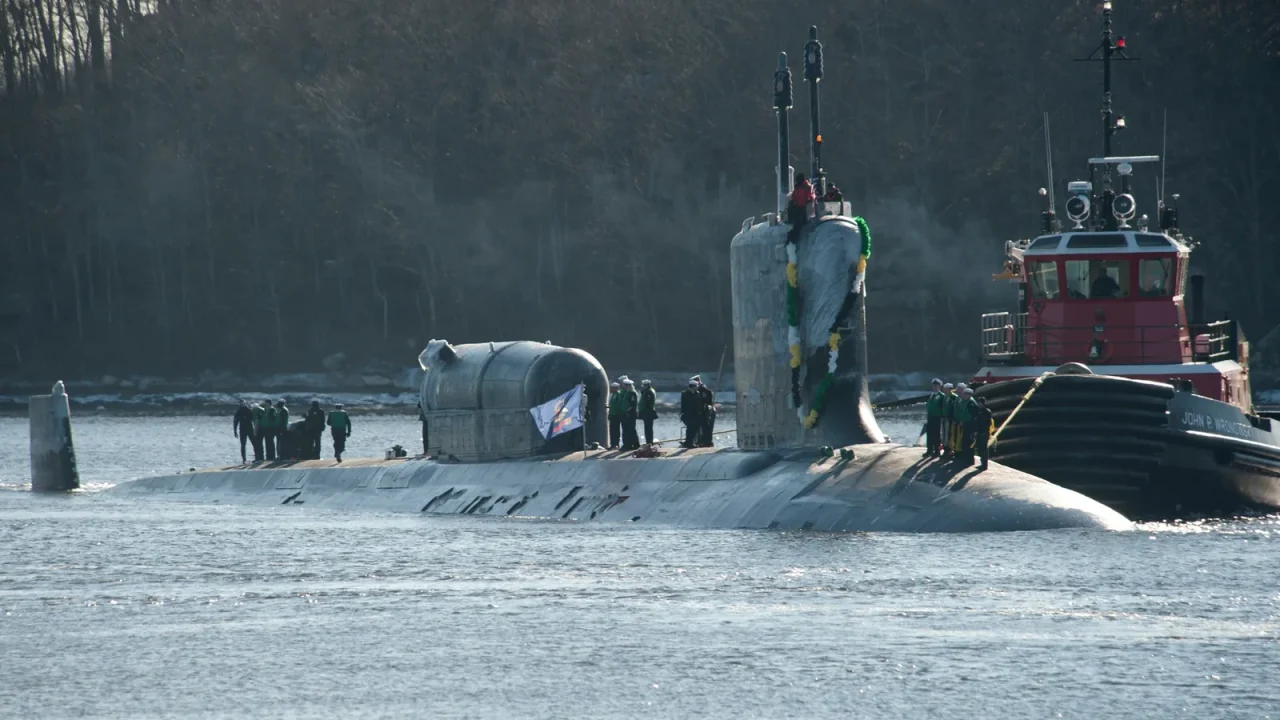
- January 2019 — home from its maiden deployment. The Navy said the boat had been operating in the European area. The photo at the top of this guide was taken that day.
- January 2021 — home from a six-month deployment. The Navy noted that 38 sailors earned their submarine “Dolphins” during the trip.
- October 2022 — home from a seven-month deployment, again to the European area, after steaming nearly 40,000 nautical miles.
- April 2023 — into the shipyard. The boat arrived at Portsmouth Naval Shipyard in Kittery, Maine, for a long period of maintenance and upgrades.
- February 2026 — undocked. The Navy reported that the submarine had left dry dock after repairs, inspections and the replacement of mechanical and electrical systems.
- Late summer 2026 — work complete. The shipyard marked the submarine’s delivery back to the fleet.
Dolphins are the submarine warfare badge. A sailor earns them by learning every major system on the boat and proving it in front of the crew. Until then, a new submariner is still “qualifying”. Earning Dolphins is a major moment in a submarine career.
Do not expect day-to-day updates on any submarine. The Navy shares homecomings, ceremonies and shipyard milestones, and little else. We last reviewed this section in October 2026.
What is life like on board?
A Virginia-class submarine is longer than a football field, but most of that space is taken up by machinery, weapons and the reactor. The crew lives and works in what is left.
- Space is tight. Bunks are stacked, and personal storage is small.
- There are no windows. The crew can go weeks without seeing daylight.
- Contact with home is limited. Messages are short and not always possible.
- The food has a good reputation. Good meals matter a great deal when there is little else to look forward to.
- Everyone has more than one job. Each sailor must be able to respond to fire, flooding and other emergencies.
It is not for everyone. But submariners are volunteers, and many say the closeness of the crew is the best part. For a wider look at Navy life at sea, read what life on a Navy ship is really like.
Real-life situations
1. You are from North Dakota
Namesake states often build real ties with “their” vessel. Crew members visit, and local groups support the boat and its families. It is worth looking up whether a support group is active in the state.
2. Someone in your family serves on a submarine
Expect long quiet periods. Agree before they leave how you will handle bills, news and emergencies. The boat’s ombudsman is your link to the command while it is away.
3. You are writing a school report
The simplest angle is “what changed with Block III”. Use the comparison table above. Be careful with dates: christened in 2013, commissioned in 2014.
4. You want to see a submarine
You cannot tour an active submarine. But the Submarine Force Museum in Groton, Connecticut, is home to the historic submarine USS Nautilus, the world’s first nuclear-powered submarine, which visitors can walk through.
5. You are thinking about volunteering for submarines
Submarine duty is voluntary and has its own screening. Start with our guide to how to join the Navy, then ask a recruiter about submarine programmes. Our ASVAB guide will help with the entry test.
Common mistakes (and the fix for each)
⚠️ Mistake: Saying the submarine entered service in 2013.
✅ Fix: It was christened in 2013 and commissioned in October 2014.
⚠️ Mistake: Mixing it up with the battleship North Dakota.
✅ Fix: The battleship was BB-29. The submarine is SSN-784.
⚠️ Mistake: Thinking it carries nuclear missiles.
✅ Fix: It is nuclear-powered. Attack submarines carry conventional Tomahawks and torpedoes.
⚠️ Mistake: Assuming Block III boats carry more missiles.
✅ Fix: The number in the tubes is the same, 12. The change is in how they are carried.
⚠️ Mistake: Calling every submarine a “nuclear sub” in the same sense.
✅ Fix: SSN, SSBN and SSGN are three different jobs. Check the letters.
⚠️ Mistake: Expecting to find the boat’s current location online.
✅ Fix: Submarine movements are not published. Only milestones are.
Pro tips for learning about a Navy submarine
- Search by hull number. “SSN 784” finds official photos and captions faster than the name.
- Read the photo captions. Navy captions give dates and places you can rely on.
- Learn the letters. SSN, SSBN and SSGN tell you what a submarine is for.
- Know the block. For Virginia-class boats, the block tells you what the boat can carry.
- Visit a museum boat. Walking through one teaches more than any diagram.
Want to go deeper?
Here are three good next steps: one to build, one that explains how a submarine works, and one that tells the story of what submarines have done. We chose them by researching what each one covers and who it suits. We have not tested them hands-on, and we list the trade-offs. Read how we choose products.
| Product | Best for | Key feature | Price level | Link |
|---|---|---|---|---|
| Best for buildersHobby Boss 1/350 USS Virginia (SSN-774) Model Kit | Building a Virginia-class submarine | About 13 inches long when finished | Budget | See on Amazon (opens in a new tab) |
| Best explainerSubmarine: A Guided Tour Inside a Nuclear Warship | Understanding how an attack submarine works | A room-by-room tour with diagrams | Budget | See on Amazon (opens in a new tab) |
| Best historyBlind Man's Bluff | The story of Cold War submarine missions | A bestselling narrative history | Budget | See on Amazon (opens in a new tab) |
Price level is a broad guide, not a live price. Scroll the table sideways on small screens.
Hobby Boss 1/350 USS Virginia (SSN-774) Model Kit
Budget
A plastic kit of USS Virginia, the first boat of North Dakota’s class. At 1/350 scale the finished model is about 12.9 inches long. A submarine has a simple shape, which makes this a friendly first ship kit.
Ideal for: First-time modellers and anyone who wants a Virginia-class boat on the shelf.
- Decals for the hull, including draft marks
- Painting guide with three-view art
- Compact finished size
- Brand
- Hobby Boss
- Scale
- 1/350
- Subject
- USS Virginia (SSN-774)
- Finished length
- about 12.9 inches
- Extras
- Hull decals and a painting guide
What we like
- Simple shape that is quick to build
- Small enough for any shelf
- Same class as North Dakota
Trade-offs
- Shows the earlier bow design, not the Block III bow
- Glue and paint are usually sold separately, so check the listing
- Delivery can take several days
Submarine: A Guided Tour Inside a Nuclear Warship
Budget
Tom Clancy’s non-fiction tour of a nuclear attack submarine, room by room, with diagrams and photographs. It explains sonar, weapons, the reactor and daily routine in a way that a newcomer can follow. It describes an older class than North Dakota, but the basics of how an attack submarine works have not changed.
Ideal for: Readers who want to understand what each part of a submarine does.
- Guided tour of an attack submarine
- Diagrams and photographs
- Covers roles and missions
- Authors
- Tom Clancy and John Gresham
- Format
- Paperback
- Length
- 368 pages
- This edition
- May 2003 reissue
- Page size
- about 6 x 9 inches
What we like
- Clear and readable
- Explains the technology without jargon
- Inexpensive paperback
Trade-offs
- First written in the 1990s, before the Virginia class
- Does not cover the newest systems
- A long read if you only want the basics
Blind Man's Bluff: The Untold Story of American Submarine Espionage
Budget
A narrative history of American submarine missions during the Cold War, based on interviews with the people involved. It reads more like a thriller than a textbook, and it shows why attack submarines matter so much to the Navy.
Ideal for: Anyone who prefers true stories to technical detail.
- True stories of Cold War submarine missions
- Based on interviews
- A New York Times bestseller
- Authors
- Sherry Sontag, Christopher Drew and Annette Lawrence Drew
- Publisher
- PublicAffairs
- Format
- Paperback
- Length
- 448 pages
- This edition
- April 2016
What we like
- Hard to put down
- Explains why submarines matter
- Good value for its length
Trade-offs
- Covers the Cold War, not today’s boats
- Little technical explanation
- Much of the subject is still classified, so gaps remain
Curious about the rest of the fleet?
See how many aircraft carriers the Navy has and where they are based.
Frequently asked questions
When was USS North Dakota christened?
The submarine was christened on 2 November 2013 at General Dynamics Electric Boat in Groton, Connecticut.
Who christened USS North Dakota?
Katie Fowler, the wife of Vice Admiral Jeff Fowler, is the submarine’s sponsor and performed the christening.
When was USS North Dakota commissioned?
It was commissioned on 25 October 2014 in Groton, Connecticut, after the original May 2014 date was postponed.
What kind of submarine is USS North Dakota?
It is a Virginia-class nuclear-powered attack submarine and the first of the Block III boats, which have a redesigned bow and two large payload tubes.
Where is USS North Dakota based?
Its home port is Groton, Connecticut, at Naval Submarine Base New London.
Does USS North Dakota carry nuclear weapons?
It is nuclear-powered, but its listed weapons are Tomahawk cruise missiles and Mk 48 torpedoes. The Navy’s nuclear deterrent is carried by ballistic missile submarines, a different type.
Your quick-reference checklist
- Christened: 2 November 2013, Groton, Connecticut.
- Sponsor: Katie Fowler.
- Commissioned: 25 October 2014.
- Type: Virginia-class nuclear-powered attack submarine (SSN).
- First of Block III: new bow, two large payload tubes.
- Size: 377 feet long, about 7,800 tons submerged.
- Home port: Groton, Connecticut.
- Name: the second Navy vessel called North Dakota, after battleship BB-29.
The christening in 2013 gave the submarine its name. Everything since — the deployments, the Dolphins earned, the years of quiet work under the sea — is what gave that name its meaning. 🌊
Sources
Facts last checked against these sources: October 2026.
- U.S. Navy Fact File — Attack Submarines (SSN) (updated November 2025): Virginia-class size, speed, crew, weapons, features and home ports.
- U.S. Navy / DVIDS, 31 January 2019: return from the maiden deployment.
- U.S. Navy / DVIDS, 27 October 2022: return from a seven-month deployment.
- U.S. Navy / DVIDS, 26 February 2026: undocking at Portsmouth Naval Shipyard.
- Wikipedia — USS North Dakota (SSN-784): used for construction dates, the commissioning delay and the description of the crest.
More like this
Keep reading
USS Gerald R. Ford (CVN-78): Christening, Key Facts and Where It Is Now
The aircraft carrier Gerald R. Ford (CVN-78) was christened on 9 November 2013. Here is what happened that day, what…
Does Mexico Have an Aircraft Carrier? The Mexican Navy Explained
No. Mexico has never had an aircraft carrier. Here is what ships the Mexican Navy really has, why a carrier…
How Many Aircraft Carriers Does the US Have? (2026 Guide)
The U.S. Navy has 11 aircraft carriers in service. Here is the full list, why the number is 11, what…