Remembering the Seven Sailors of USS Fitzgerald (DDG 62)
Seven sailors died when USS Fitzgerald collided with a container ship off Japan on 17 June 2017. Who they were, what happened that night, what the Navy changed and how they are remembered.
In this guide
Seven sailors of the destroyer USS Fitzgerald died in the early hours of 17 June 2017, when their ship collided with a container ship off the coast of Japan. This page remembers them by name. It also sets out plainly what happened, what was learned and how they are honoured today.
The seven were in the ship’s berthing spaces, where sailors sleep, when the sea came in. They were aged 19 to 37. They came from seven towns in six states. Between them they looked after the ship’s guns, sonar, weapons systems, pay and paperwork.
Their shipmates fought for hours to keep the ship afloat, and they brought her home. Both things are true of that night: a terrible loss, and a crew that did not give up.
The seven sailors
The Navy named the seven on 18 June 2017, after their families had been told. They are listed here in the order the Navy gave.
| Name | Rate | Age | Home town |
|---|---|---|---|
| Dakota Kyle Rigsby | Gunner’s Mate Seaman | 19 | Palmyra, Virginia |
| Shingo Alexander Douglass | Yeoman 3rd Class | 25 | San Diego, California |
| Ngoc T. Truong Huynh | Sonar Technician 3rd Class | 25 | Oakville, Connecticut |
| Noe Hernandez | Gunner’s Mate 2nd Class | 26 | Weslaco, Texas |
| Carlos Victor Ganzon Sibayan | Fire Controlman 2nd Class | 23 | Chula Vista, California |
| Xavier Alec Martin | Personnel Specialist 1st Class | 24 | Halethorpe, Maryland |
| Gary Leo Rehm Jr. | Fire Controlman 1st Class | 37 | Elyria, Ohio |
Source: the U.S. Navy’s announcement of 18 June 2017, as carried by CBS News and other outlets.
What their jobs were
A sailor’s “rate” is their job and their rank together. The seven held five different jobs. Each one is a part of what keeps a warship working.
- Gunner’s Mate. Gunner’s mates look after the ship’s guns, missile launchers and small arms, and the magazines where ammunition is stored.
- Yeoman. Yeomen run the ship’s office. They handle letters, records, awards and the paperwork that follows every sailor through a career.
- Sonar Technician. Sonar technicians listen to the sea. They use sonar to find and track submarines and other things under the water.
- Fire Controlman. Fire controlmen operate and repair the radars and computers that aim the ship’s weapons. On a destroyer like Fitzgerald that includes the Aegis combat system.
- Personnel Specialist. Personnel specialists look after pay, travel claims and service records. When a sailor’s pay is right, a personnel specialist is usually the reason.
A whole crew in seven lines
Look down the list and you see a whole ship’s company in seven lines. There is a seaman of 19 near the start of his time in the Navy. There are petty officers in their twenties who had already become skilled at technical work. And there is a first class petty officer of 37, a rank that younger sailors look to for guidance.
They came from Virginia, California, Connecticut, Texas, Maryland and Ohio. Like every crew, they were people from very different places who had learned to rely on each other.
What happened on 17 June 2017
USS Fitzgerald was based at Yokosuka, the big U.S. Navy base south of Tokyo. On the night of 16 June 2017 she was at sea off the Japanese coast, heading roughly south at about 20 knots. The night was clear.
The waters there are busy. Ships going to and from Tokyo Bay cross them all day and all night.
At about 1:30 a.m. on 17 June, Fitzgerald and a merchant ship called ACX Crystal collided. ACX Crystal was a container ship sailing under the flag of the Philippines, and she was much larger and heavier than the destroyer. The collision happened about 56 nautical miles south-west of Yokosuka.
The container ship’s bow struck Fitzgerald on her right-hand side, which sailors call the starboard side. Big merchant ships have a rounded nose that sits under the water at the front. That part went through the destroyer’s hull below the waterline.
Sea water poured in. It flooded a machinery space, the radio room and two berthing spaces. The commanding officer’s cabin was destroyed, and he was among the injured.
| When | What happened |
|---|---|
| About 1:30 a.m., 17 June 2017 | Fitzgerald and ACX Crystal collide about 56 nautical miles south-west of Yokosuka |
| The minutes that followed | Sea water floods a machinery space, the radio room and two berthing spaces |
| The hours that followed | The crew fights the flooding and keeps the ship afloat |
| After the collision | The injured commanding officer is flown to hospital by a Japanese military helicopter. Other injured sailors are flown out by U.S. military helicopters |
| The return to port | Fitzgerald comes back to Yokosuka with help from tugs, the destroyer USS Dewey and the Japan Coast Guard |
| After the return | The seven sailors, first listed as missing, are found in the flooded berthing spaces |
| 18 June 2017 | The Navy names the seven sailors |
| 27 June 2017 | A memorial ceremony is held at Fleet Activities Yokosuka |
| 28 June 2017 | A memorial ceremony is held at the Pentagon |
Japan helped from the first hour. The Japan Coast Guard and the Japan Maritime Self-Defense Force both joined the search and rescue effort. The Navy thanked both services publicly for what it called their immense support.
How the crew saved the ship
It would have been possible to lose the ship that night. The commander of the U.S. Seventh Fleet at the time described a large gash near the keel, the very bottom of the hull. A hole that low lets in a great deal of water very quickly.
What stopped it was the crew. Sailors call the work damage control. It took hours, through the night, on a ship whose radio room was under water.
Damage control is everything a crew does to keep a damaged ship afloat and fighting. That includes shutting watertight doors and hatches to trap flooding in as few spaces as possible, pumping water out, bracing weakened walls, putting out fires and looking after the injured. Every sailor learns the basics in boot camp, and crews practise it constantly at sea.
With the commanding officer injured, the executive officer, who is the second in command, took charge. The crew stopped the flooding from spreading and kept the ship stable. Fitzgerald then made her way back to Yokosuka with tugs alongside.
The crew of Fitzgerald lost seven shipmates and still brought their ship home. Remembering that night means holding both of those facts together.
It is worth saying clearly. The sailors who survived that night were not only victims of a collision. They were the reason there was still a ship to repair, and the reason more families did not receive the worst news.
The ship they served in
USS Fitzgerald is a guided-missile destroyer of the Arleigh Burke class, the backbone of the U.S. Navy’s surface fleet. Destroyers are fast, heavily armed ships that can defend against aircraft and missiles, hunt submarines and strike targets on land.
The ship is named for Lieutenant William Charles Fitzgerald, a Navy officer who was killed in Vietnam on 7 August 1967. When the base where he was an adviser was overrun, he ordered his men to withdraw and stayed behind in his bunker to cover them. He was awarded the Navy Cross. His widow, Betty A. Fitzgerald, was the ship’s sponsor.
So the ship has carried a story of sacrifice for shipmates since the day she was named.
| Fact | Detail |
|---|---|
| Hull number | DDG 62 |
| Class | Arleigh Burke-class guided-missile destroyer (Flight I) |
| Builder | Bath Iron Works, Bath, Maine |
| Keel laid | 9 February 1993 |
| Launched | 29 January 1994 |
| Commissioned | 14 October 1995, at Newport, Rhode Island |
| Length | 505 feet (about 154 metres) |
| Beam (width) | 59 feet (18 metres) |
| Speed | More than 30 knots |
| Home port in 2017 | Yokosuka, Japan, where she had been based since 2004 |
| Home port today | San Diego, California |
Sources: U.S. Navy fact file for DDG 51-class destroyers, updated 7 July 2026, and the ship’s published history.
You can read about other ships and how the fleet is organised in our Navy Ships and Fleet section.
What the investigations found
Several investigations followed, in the United States and in Japan. Their findings are uncomfortable, and it would not honour the seven to soften them.
The Navy released its own report on 1 November 2017. Its summary said the collision was avoidable. It said the cause was a build-up of smaller errors over time, which ended in the ship not following sound navigation practice.
In plain terms, the Navy found three things:
- The watch teams did not keep proper track of the ships around them. Lookout duties were not carried out on the starboard side, where ACX Crystal and two other ships were approaching.
- Leaders did not follow well-established rules that exist to prevent collisions.
- The ship’s most senior leaders were not on the bridge at a time when their experience would have helped.
The Chief of Naval Operations at the time said both of that summer’s collisions were preventable. He added: “We must do better.”
| Who looked into it | When | Main finding |
|---|---|---|
| U.S. Navy | Report released 1 November 2017 | The collision was avoidable. Watch teams and leaders did not follow basic, established practice |
| Japan Transport Safety Board | Final report, August 2019 | Distraction and incomplete radar information aboard the destroyer led to the collision |
| Findings about ACX Crystal | Reported in 2019 | The container ship was on autopilot until shortly before the collision. It did not sound warning blasts or try to call the destroyer by radio |
| U.S. Government Accountability Office | Reports in 2019 and 2021 | The Navy found that overwork, fatigue and gaps in training contributed to the 2017 collisions |
So both ships made mistakes. The owners of ACX Crystal later agreed to pay the U.S. government nearly $27 million. The Navy’s own report, though, looked at what went wrong in its own ship.
Who was held to account
We have chosen not to name individuals in this section. This page is about the seven who died, and the public record is linked in the sources for anyone who wants it.
- August 2017. The Navy announced that the ship’s commanding officer, executive officer and command master chief would be relieved of their duties. About a dozen other sailors faced non-judicial punishment.
- August and September 2017. The commander of the Seventh Fleet was relieved. Two more senior commanders above the ship were removed soon after.
- 2018. Court proceedings began against several of the ship’s officers. One junior officer pleaded guilty to a charge of dereliction of duty.
- 2019. The Navy dropped the remaining criminal charges.
The wider causes
It is easy to stop at the bridge of one ship on one night. The Navy’s own later work went further. It found that sailors across the surface fleet were overworked and tired, and that officers were not getting enough training and practice in driving ships.
That matters for how we remember this. The seven did not die because one person had one bad night. They died because many small things had been allowed to go wrong over a long time. Our explainer on how the Navy investigates mishaps describes why serious accidents almost always have several causes.
Two months later: USS John S. McCain
On 21 August 2017, just over two months after the Fitzgerald collision, another destroyer from the same squadron collided with a merchant ship. USS John S. McCain struck the tanker Alnic MC near Singapore. Ten sailors died.
The two ships shared a home port and a chain of command. The Navy found that the McCain collision was also avoidable.
That same day, the Navy ordered a pause in operations across the whole fleet so that every ship could stop and check its basic safety practices. It also began a full review of how its surface ships were trained, crewed and worked.
In two months, 17 sailors had been lost in two collisions that should not have happened. The seven from Fitzgerald and the ten from John S. McCain are often remembered together.
What the Navy changed afterwards
One lasting way to honour sailors lost in a preventable accident is to prevent the next one. That is why this section belongs in a remembrance.
The Government Accountability Office, which checks on federal agencies for Congress, has followed the Navy’s changes closely. Its reports give an independent view of what was done and what is still unfinished.
| Area | What changed | What reviewers found later |
|---|---|---|
| Fatigue | The Navy issued a fatigue management policy in 2017 and updated it in December 2020. In 2022 it required ships to collect regular data on how tired sailors are | In a 2020 survey, an estimated 14 percent of officers got seven or more hours of sleep a day on their latest deployment. About 67 percent got five hours or less |
| Ship-driving training | More classroom and simulator time for the officers who drive ships, with a plan to triple their early ship-driving training hours, and new simulator buildings | In 2019 the Navy had no plan yet to gather fleet-wide feedback on whether the new training was working |
| Skill checks | Extra checks of ship-driving skill through an officer’s career, and logbooks to record experience | Navy inspectors had concerns about the ship-driving skills of more than 80 percent of the officers they checked |
| Crew sizes | From February 2021 the Navy began measuring crews against the number of sailors a ship needs, not only the number it has money for | Crew shortfalls averaged 15 percent in September 2020, up from 8 percent in October 2016 |
| Bridge controls | In 2019 the Navy said it would replace touchscreen steering and throttle controls in its destroyers with physical wheels and throttles. This came mainly out of the John S. McCain collision |
Sources: GAO-20-154 (November 2019) and GAO-21-366 (May 2021).
The honest summary is this. The Navy made real changes, and it made them because of what happened to these sailors. The reviewers also found that tiredness and short crews did not go away. The work is not finished.
The lessons of 17 June 2017 are simple to say and hard to live by. Get the sleep you can. Speak up when something looks wrong, whatever your rank. Take lookout and watch duties seriously, even on a quiet night. And treat every damage control drill as if it were real, because one night it may be.
Repair and return to the fleet
Some people assume a ship so badly damaged must have been scrapped. She was not. The Navy decided to repair USS Fitzgerald and bring her up to date at the same time.
| Date | Step |
|---|---|
| 11 July 2017 | Fitzgerald enters dry dock at Yokosuka so the damage can be inspected |
| August 2017 | Huntington Ingalls Industries is chosen to repair her at its shipyard in Pascagoula, Mississippi |
| Late November 2017 | She is loaded on to a heavy-lift ship for the voyage across the Pacific |
| January 2018 | She arrives in Pascagoula |
| 3 February 2020 | She leaves the shipyard for sea trials, her first time at sea under her own power since 2017 |
| 13 June 2020 | She sails from Pascagoula for San Diego, her home port |
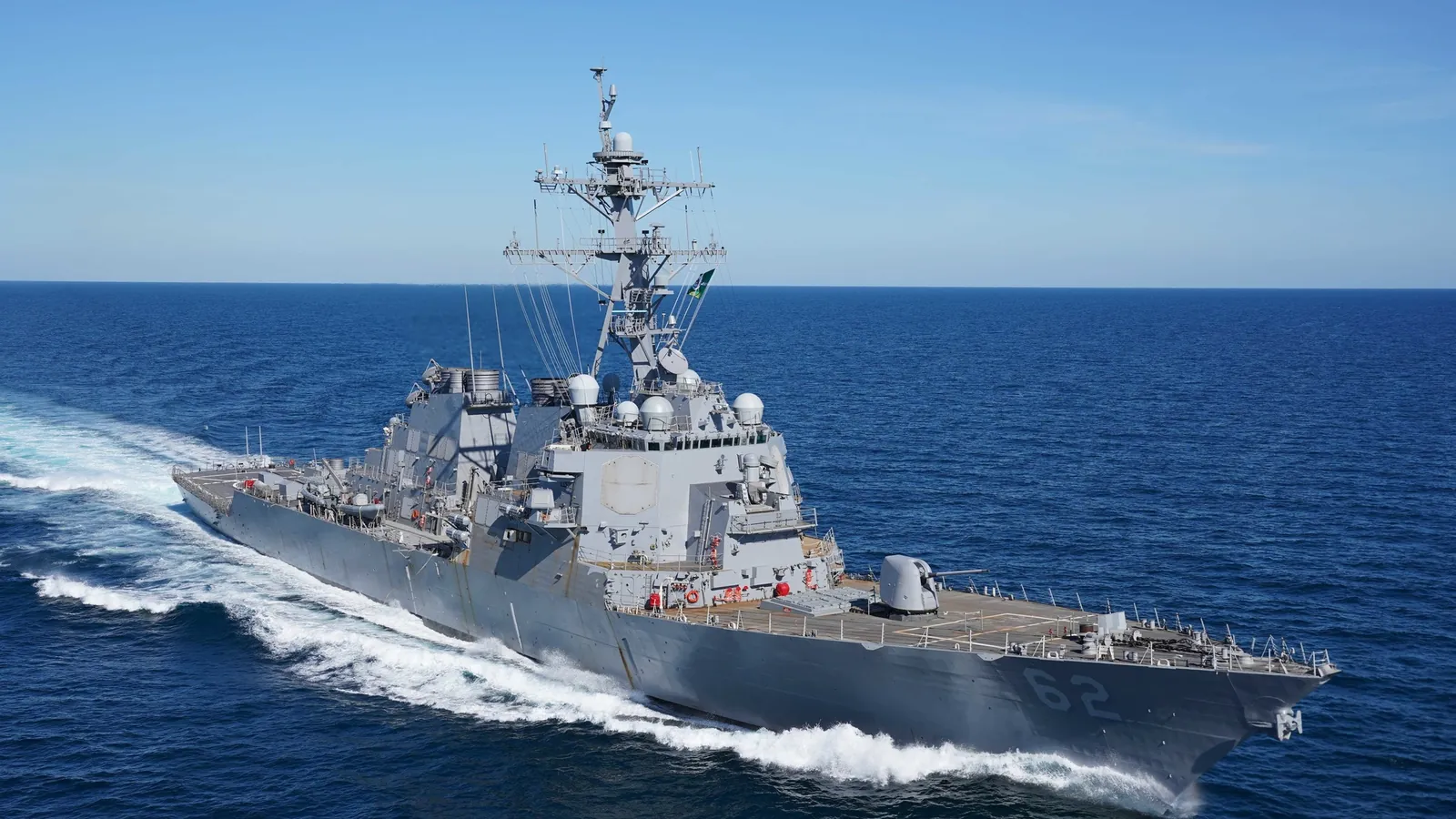
The work was large. Together with upgrades that had already been planned for the ship, it was expected to cost about $368.7 million.
Since 2020 Fitzgerald has deployed again and trained with allied navies across the Pacific. The Navy’s current list of destroyers shows her based in San Diego.
For the people who knew the seven, the ship’s return carries a mixed meaning. It is good that she sails. It is also a reminder of who is not aboard.
How the seven are remembered
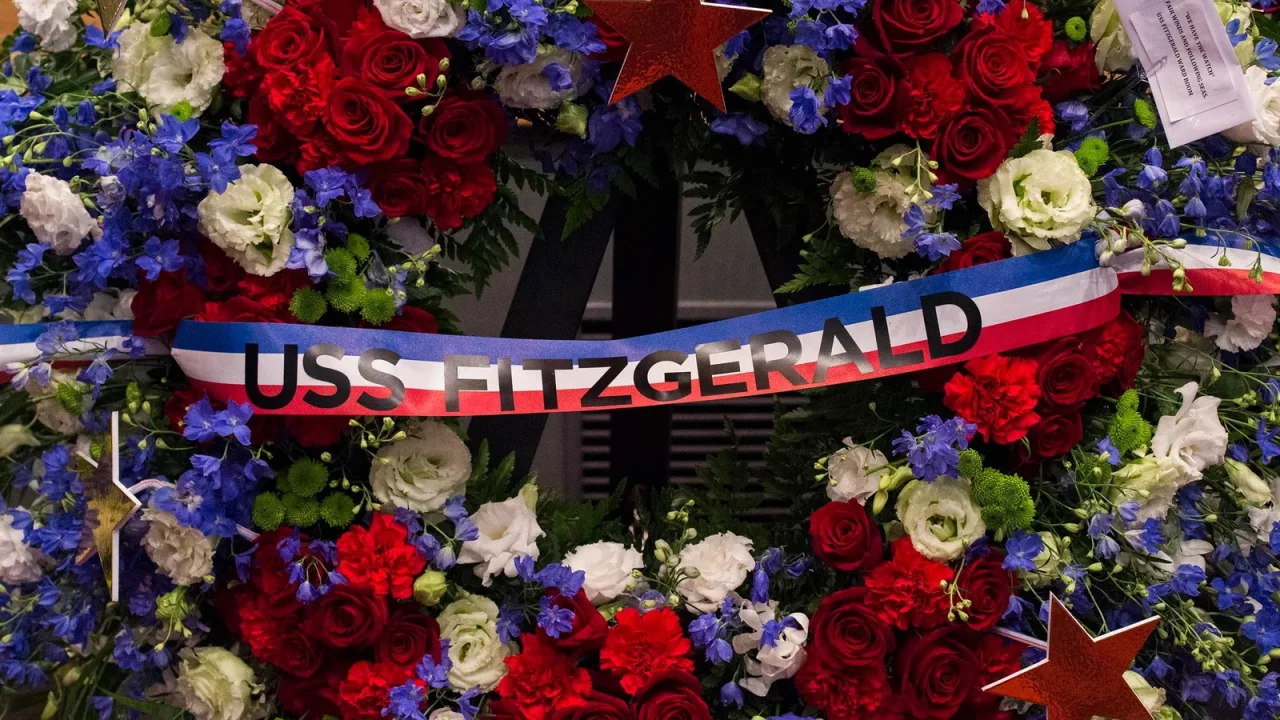
The first memorial was held ten days after the collision. On 27 June 2017, families, friends and shipmates gathered at Fleet Activities Yokosuka. The photograph at the top of this page shows a wreath from that ceremony, with a ribbon bearing the ship’s name.
The next day, 28 June, a second ceremony was held at the Pentagon. A petty officer who had once served in Fitzgerald stood as the bell ringer.
The traditions you will see at a Navy memorial
- The tolling of the bell. A ship’s bell is often rung as each name is read. On a ship the bell marks the passing of time, so ringing it for a shipmate has a meaning every sailor understands.
- Taps. This is the short bugle call played at military funerals and memorials. It has 24 notes. People stand in silence while it is played, and those in uniform salute.
- A wreath. Flowers are laid in memory of the dead. At sea, a wreath is sometimes placed on the water.
- The flag at half-mast. The national flag is lowered part-way as a sign of mourning.
- A moment of silence. Often the simplest part, and the one people remember.
Simple ways to honour them
- Say their names. Rigsby. Douglass. Huynh. Hernandez. Sibayan. Martin. Rehm. A name spoken aloud is the oldest kind of memorial.
- Mark 17 June. A minute of quiet on that date is enough.
- Learn what really happened. Use the official record, not rumour. The sources at the end are a start.
- Support the families of the fallen. Groups that care for military survivors always need help. Our guide to military service organizations lists trusted ones.
- Be careful online. Do not share graphic images, guesses or attacks on individual sailors. Families read what is posted.
- If you serve, stand a good watch. For a sailor, there is no better tribute.
Support if this is hard to read
Anniversaries, news stories and pages like this one can bring grief back sharply, even years later. That is normal, and help is available.
Dial 988 and press 1 for the Military and Veterans Crisis Line. It is free and confidential, at any hour. The Tragedy Assistance Program for Survivors (TAPS), a charity for anyone grieving a military death, answers its helpline day and night on 800-959-TAPS (8277).
- Chaplains. Every command has access to a chaplain. What you tell them stays private, and you do not need to be religious.
- Fleet and Family Support Centers. These offer free counselling to sailors and families on base.
- The Navy Gold Star Program. This is the Navy’s long-term support for the families of sailors who die on active duty.
- A Casualty Assistance Calls Officer. When a sailor dies, the Navy assigns one to the family to help with benefits, arrangements and questions.
- Shipmates. Often the people who understand best are the ones who were there. Staying in touch matters.
You will find the official support sites in our master Navy links list.
Real-life situations
1. You served in Fitzgerald, or you knew one of the seven
Nothing on a web page will match what you carry. If June is a hard month, plan for it. Tell someone you trust, reach out to old shipmates, and use the support lines above if you need them. If anything on this page is wrong, please tell us.
2. Someone you love is about to go to sea
Reading about a collision is frightening. It may help to know that events like this are rare, that the Navy changed training and rest rules because of it, and that the Navy tells families directly and quickly if a sailor is hurt. Talk about your worry openly before the ship leaves.
3. You are a student or writer researching the collision
Start with the Navy’s own report and the Government Accountability Office reviews. Be exact with names, rates and dates. Keep what is confirmed apart from what is opinion, and remember that the families may read your work.
4. You are a junior sailor about to stand watch on the bridge
This story is part of your training for a reason. Know the rules for avoiding collisions. Report every ship you see, even if you think someone else has. If you are too tired to stand a safe watch, say so. Calling a senior officer to the bridge is never a failure.
5. You want to pay your respects but do not know how
You do not need a ceremony. Read the seven names. Pause on 17 June. If you want to do more, give time or money to a group that supports military families.
Common misunderstandings (and the facts)
Misunderstanding: USS Fitzgerald sank.
Fact: She did not. The crew kept her afloat and she returned to Yokosuka.
Misunderstanding: The ship was scrapped afterwards.
Fact: She was repaired, went back to sea in 2020 and is based in San Diego.
Misunderstanding: The seven sailors were on watch at the time.
Fact: They were in berthing spaces that flooded.
Misunderstanding: Only one ship was at fault.
Fact: Investigators found errors on both ships. The Navy said its own ship could have avoided the collision.
Misunderstanding: Fitzgerald and John S. McCain were the same accident.
Fact: They were two separate collisions, two months apart. Seven sailors died in the first and ten in the second.
Misunderstanding: Nothing changed afterwards.
Fact: The Navy changed rest rules, training and bridge equipment. Reviewers say more work is needed.
Frequently asked questions
Who were the seven sailors who died on USS Fitzgerald?
They were Gunner’s Mate Seaman Dakota Kyle Rigsby, Yeoman 3rd Class Shingo Alexander Douglass, Sonar Technician 3rd Class Ngoc T. Truong Huynh, Gunner’s Mate 2nd Class Noe Hernandez, Fire Controlman 2nd Class Carlos Victor Ganzon Sibayan, Personnel Specialist 1st Class Xavier Alec Martin and Fire Controlman 1st Class Gary Leo Rehm Jr.
When and where did the USS Fitzgerald collision happen?
It happened at about 1:30 a.m. local time on 17 June 2017, around 56 nautical miles south-west of Yokosuka, Japan.
What ship did USS Fitzgerald collide with?
She collided with ACX Crystal, a container ship sailing under the flag of the Philippines.
What caused the USS Fitzgerald collision?
The Navy said the collision was avoidable and resulted from a build-up of smaller errors, with watch teams and leaders not following established navigation practice. Investigators also found errors aboard the container ship.
Is USS Fitzgerald still in service?
Yes. She was repaired in Pascagoula, Mississippi, went back to sea for trials on 3 February 2020 and is now based in San Diego, California.
What did the Navy change after the 2017 collisions?
It issued a fatigue management policy, added classroom and simulator training for the officers who drive ships, added ship-driving skill checks and said it would replace touchscreen bridge controls in destroyers with physical wheels and throttles.
Key facts to keep
- Seven sailors died aboard USS Fitzgerald (DDG 62) on 17 June 2017.
- Where: about 56 nautical miles south-west of Yokosuka, Japan.
- What happened: a collision with the container ship ACX Crystal at about 1:30 a.m.
- The crew saved the ship after hours of damage control.
- The Navy’s finding: the collision was avoidable.
- Two months later, ten sailors died in USS John S. McCain.
- The Navy changed rest rules, ship-driving training and bridge controls.
- The ship returned to sea in 2020 and serves from San Diego.
- Help is there: dial 988 and press 1, or call TAPS on 800-959-8277.
Dakota Rigsby. Shingo Douglass. Ngoc Truong Huynh. Noe Hernandez. Carlos Sibayan. Xavier Martin. Gary Rehm Jr.
They were somebody’s family and somebody’s friends long before they were names on a list, and they were shipmates to nearly 300 others who still carry them. Fair winds and following seas.
Sources
Facts last checked against these sources: October 2026.
- U.S. Navy — “Navy Releases Collision Report for USS Fitzgerald and USS John S McCain Collisions” (1 November 2017, archived copy): the Navy’s summary of its findings.
- U.S. Government Accountability Office — GAO-21-366 (May 2021): fatigue, crew shortfalls and training in the surface fleet.
- U.S. Government Accountability Office — GAO-20-154 (November 2019): changes to ship-driving training after the 2017 collisions.
- U.S. Navy fact file — Destroyers (DDG 51): the class’s size and speed, and the ship’s current home port.
- DVIDS — memorial ceremony at Fleet Activities Yokosuka, 27 June 2017, and memorial ceremony at the Pentagon, 28 June 2017.
- DVIDS — USS Fitzgerald conducts sea trials, 3 February 2020.
- Wikipedia — USS Fitzgerald and MV ACX Crystal collision and USS Fitzgerald: summaries of press reporting on the timeline, the legal proceedings, the repair and the ship’s history, with links to the original reports.
- Tragedy Assistance Program for Survivors (TAPS): support for anyone grieving a military death.
- MyNavy HR — Casualty Assistance: the Navy’s casualty support for families.
More like this
Keep reading
USS North Dakota (SSN-784): Christening, Key Facts and the Submarine Today
The submarine USS North Dakota (SSN-784) was christened on 2 November 2013. Here are the key facts, what its Block…
USS Gerald R. Ford (CVN-78): Christening, Key Facts and Where It Is Now
The aircraft carrier Gerald R. Ford (CVN-78) was christened on 9 November 2013. Here is what happened that day, what…
Does Mexico Have an Aircraft Carrier? The Mexican Navy Explained
No. Mexico has never had an aircraft carrier. Here is what ships the Mexican Navy really has, why a carrier…