USS Gerald R. Ford (CVN-78): Christening, Key Facts and Where It Is Now
The aircraft carrier Gerald R. Ford (CVN-78) was christened on 9 November 2013. Here is what happened that day, what makes the ship different from older carriers, and where it is now.
Some links on NavyMentor are affiliate links. If you buy through one, we may earn a commission at no extra cost to you. It never changes what we recommend. How this works
In this guide
The aircraft carrier Gerald R. Ford (CVN-78) was christened on 9 November 2013 at Newport News Shipbuilding in Virginia. President Ford’s daughter, Susan Ford Bales, broke a bottle of sparkling wine across the bow. It was the first new class of American aircraft carrier in more than 40 years.
A christening is a proud day, but it is not the day a ship joins the Navy. The Ford still had years of building and testing ahead. It was not commissioned until 2017, and it did not make its first full deployment until 2023.
This guide tells the whole story in plain English: what happened on christening day, what a christening actually means, what makes this ship different from every carrier before it, and where the Ford is today. ⚓
What happened at the christening
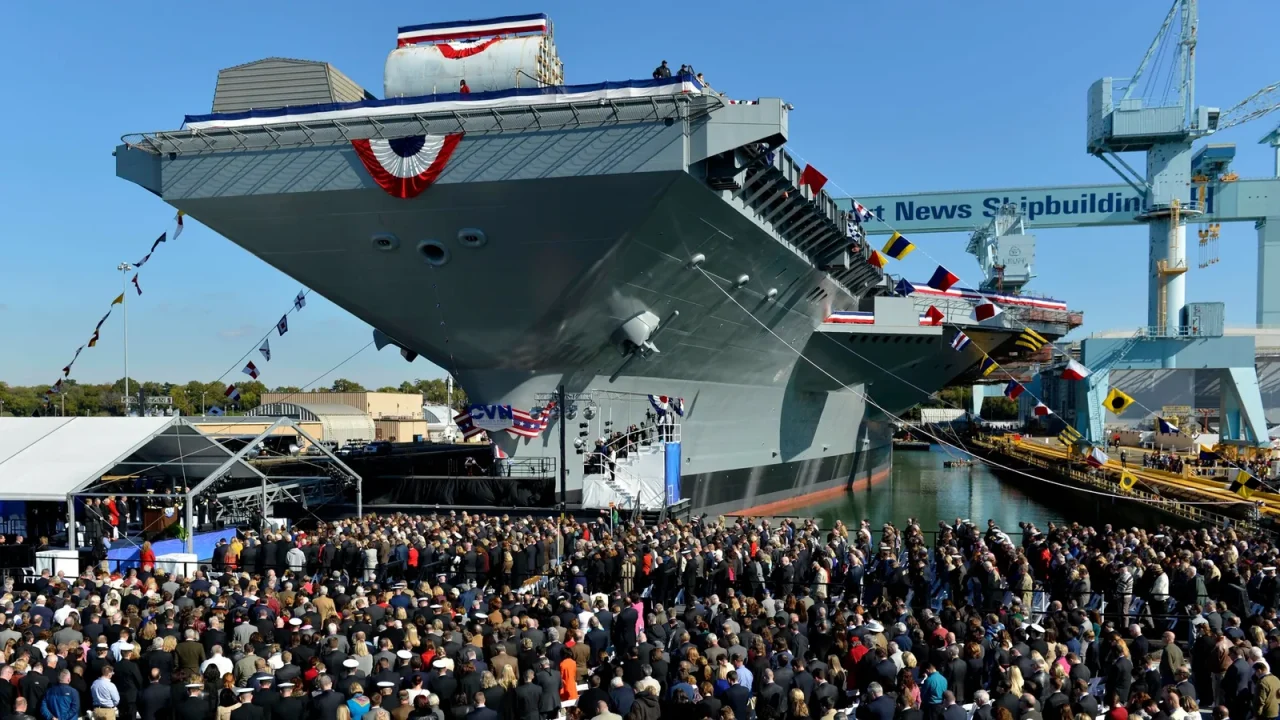
The ceremony took place on Saturday, 9 November 2013, at the Newport News shipyard in Virginia. This is the only yard in the United States that builds nuclear-powered aircraft carriers.
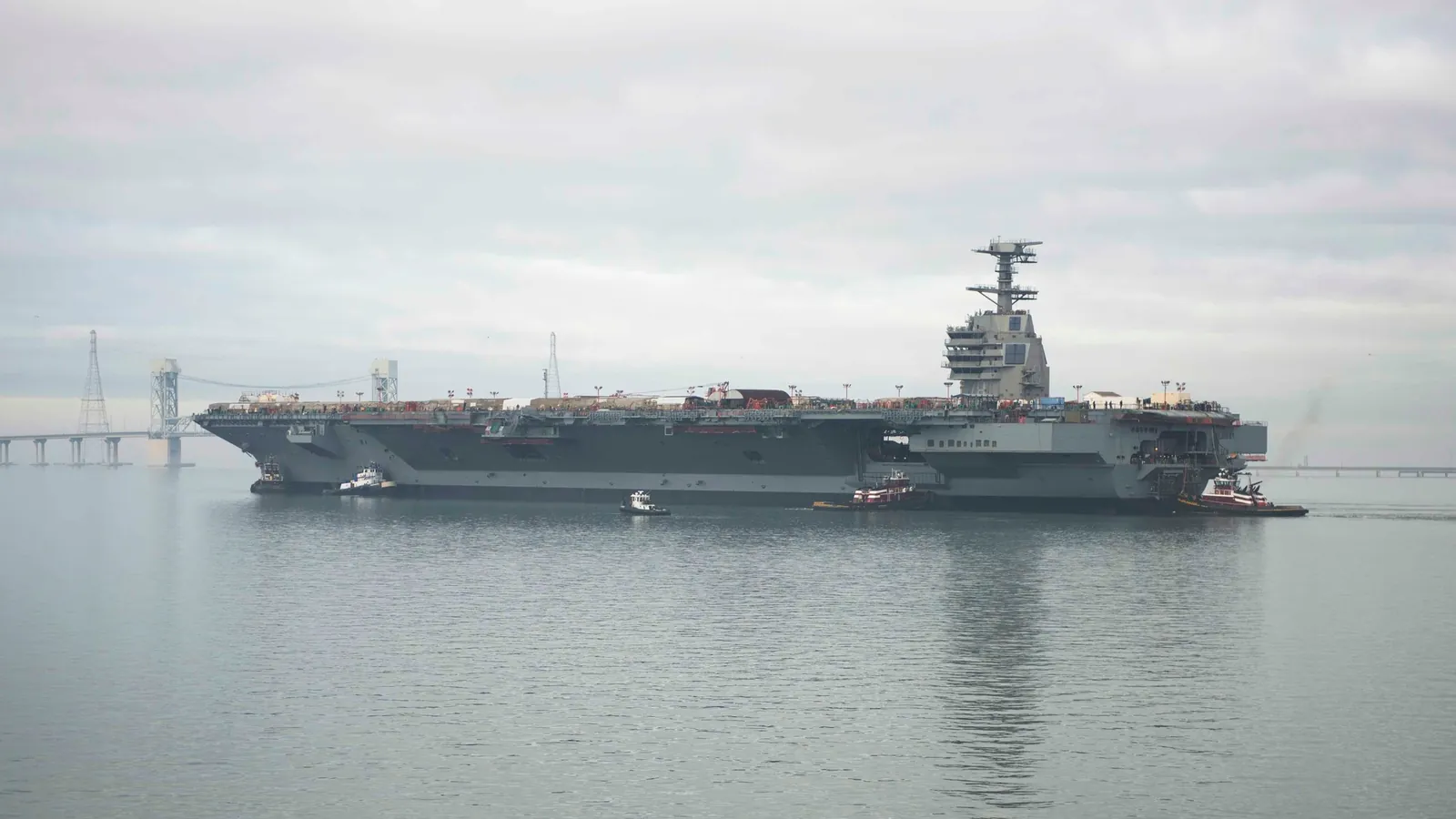
Thousands of people came. The photo at the top of this guide was taken that day. You can see the crowd gathered under the huge bow, which was hung with red, white and blue bunting.
The key moment in any christening belongs to the ship’s sponsor. For this ship that was Susan Ford Bales, the daughter of President Gerald R. Ford. She broke a bottle of American sparkling wine against the hull and formally gave the ship its name.
The ship was not yet “USS”
Here is a detail many people miss. On christening day the ship was not called USS Gerald R. Ford. It was called PCU Gerald R. Ford. PCU stands for Pre-Commissioning Unit.
A Navy ship only earns the letters USS, for United States Ship, on the day it is commissioned. Until then it still belongs to the shipbuilder. So for nearly four more years, the Ford was a PCU.
Launched before it was christened
One more surprise: the ship was already afloat. The dry dock had been flooded a month earlier, on 11 October 2013. That is the moment the Navy counts as the launch. The naming ceremony followed on 9 November. A week later, tugboats moved the ship along the James River to a pier for the next stage of building.
What is a ship christening?
A christening is a naming ceremony. It is one of the oldest traditions at sea. The custom of blessing a new ship before it sails goes back thousands of years.
In the U.S. Navy today, the tradition has a few fixed parts:
- A sponsor. The Secretary of the Navy chooses one. The sponsor is very often a woman with a link to the ship’s namesake.
- A bottle. The sponsor breaks a bottle of sparkling wine across the bow.
- The words. The sponsor names the ship aloud.
- A lifelong bond. The sponsor is thought of as part of the ship’s family for as long as it serves.
Breaking a bottle on the bow is meant to bring good luck. The bottle is usually scored beforehand and wrapped in a mesh sleeve so it breaks cleanly and safely on the first swing.
Christened, launched, commissioned: what is the difference?
People often use these words as if they mean the same thing. They do not. A warship passes several milestones on its way to the fleet, and each has its own name.
| Milestone | What it means | When it happened for the Ford |
|---|---|---|
| First steel cut | Building work begins | 11 August 2005 |
| Keel laying | The ceremonial start of construction | 14 November 2009 |
| Launch | The ship floats for the first time | 11 October 2013 |
| Christening | The ship is formally named | 9 November 2013 |
| Delivery | The Navy accepts the ship from the builder | 31 May 2017 |
| Commissioning | The ship enters service and becomes “USS” | 22 July 2017 |
| First full deployment | The ship goes to work overseas | May 2023 |
A christening gives a ship its name. A commissioning gives it a crew, a flag and a job. Nearly four years separated the two for the Ford.
Why the ship is named after Gerald R. Ford
Gerald R. Ford was the 38th President of the United States. He was also a Navy veteran. During the Second World War he served in the Pacific aboard the light aircraft carrier USS Monterey.
The Navy announced the name in January 2007, a few weeks after President Ford died. His daughter Susan was named as the ship’s sponsor. She took part in the ship’s story from the start. She helped lay the keel in 2009, chose items for a time capsule sealed inside the ship in 2013, and christened it later that year.
The ship’s motto is Integrity at the helm.
USS Gerald R. Ford at a glance
| Feature | Detail |
|---|---|
| Hull number | CVN-78 |
| Class | Gerald R. Ford class (first ship) |
| Builder | Newport News Shipbuilding, Virginia |
| Length | About 1,100 feet |
| Flight deck width | 256 feet |
| Weight | About 100,000 tons fully loaded |
| Power | Two nuclear reactors, four propeller shafts |
| Speed | More than 30 knots (about 35 mph) |
| People on board | About 4,500, including the air wing |
| Aircraft | More than 75 |
| Home port | Norfolk, Virginia |
| Motto | Integrity at the helm |
The Navy describes the Nimitz and Ford classes as the largest warships in the world. Each is designed to serve for about 50 years, with a single refuelling halfway through.
What makes the Ford different from older carriers
From a distance, the Ford looks much like the Nimitz-class carriers that came before it. Up close, almost everything that matters is new. It was the first completely new American carrier design since the 1960s.
| System | Nimitz class | Ford class |
|---|---|---|
| Launching aircraft | Steam catapults | Electromagnetic catapults (EMALS) |
| Recovering aircraft | Hydraulic arresting gear | Advanced Arresting Gear |
| Moving weapons | Cable-driven elevators | Electromagnetic weapons elevators |
| Reactors | Older design | New design making far more electricity |
| Island (the tower) | Larger, nearer the middle | Smaller, taller and further aft |
| Radar | Several rotating radars | Flat-panel radar arrays on the island |
| Crew | Larger | Several hundred fewer |
Electromagnetic catapults
Older carriers fling aircraft off the deck with steam. The Ford uses powerful electric motors instead. This system is called EMALS. It gives a smoother push, which is kinder to the aircraft, and it can be tuned for very light or very heavy planes. It also frees up the space that steam pipes once filled.
A new way to stop aircraft
Landing on a carrier means catching a wire and stopping in about two seconds. The Ford’s Advanced Arresting Gear does this with computer control, so it can handle a wider range of aircraft.
A smaller island, further back
The island is the tower on the flight deck. On the Ford it is smaller, taller and set further aft. That leaves more open deck for parking, fuelling and arming aircraft, a bit like the pit lane in motor racing.
More power for the future
The Ford’s two reactors make far more electricity than a Nimitz-class ship needs today. That spare power is deliberate. It leaves room for new systems to be added over a 50-year life.
All of this adds up to one aim. The Navy designed the Ford to launch more flights each day than a Nimitz-class ship, using a smaller crew. The Navy has estimated that this will save about $4 billion in running costs over the life of the ship.
Why it took so long, and cost so much
The Ford was first planned for delivery in 2015. It was delivered in 2017. Getting it ready to deploy took until 2023.
The main reason is that so many systems were brand new, all at once. The catapults, the arresting gear, the radar and the weapons elevators were each a first of their kind. Several took years to make reliable. The last of the eleven weapons elevators was not handed over until late 2021.
The price rose too. Building the ship cost about $13 billion, with several billion dollars more for research and development. That makes it the most expensive warship ever built.
To a degree, yes. The first ship of any new class tends to be late and over budget, because it is where the problems are found. The ships that follow are meant to benefit from those lessons.
Where is USS Gerald R. Ford now?
The Ford is based at Naval Station Norfolk, Virginia. Here is a short history of its service so far.
- 2022 — a first cruise. The ship spent about two months in the Atlantic working with allied navies, with port visits to Canada and the United Kingdom.
- 2023 to 2024 — first full deployment. The Ford left Norfolk in May 2023. It was sent to the eastern Mediterranean in October 2023 and returned home in January 2024 after about eight months away.
- 2025 to 2026 — a very long second deployment. The ship left Norfolk in June 2025 and returned in May 2026. According to the Navy and press reports, the deployment lasted 326 days and took the ship to northern Europe, the Caribbean and the Middle East. That makes it one of the longest carrier deployments in decades.
- Since May 2026 — maintenance. After returning, the ship began a long maintenance period.
A carrier’s status can change quickly, and the Navy does not publish detailed schedules. For the latest news, check the Navy’s own announcements. We last reviewed this section in October 2026.
The ships that follow the Ford
The Ford is the first of a new class. The Navy has named five more so far. Each will replace an older Nimitz-class carrier as it retires.
| Hull number | Name | Named for |
|---|---|---|
| CVN-78 | Gerald R. Ford | The 38th President |
| CVN-79 | John F. Kennedy | The 35th President |
| CVN-80 | Enterprise | A famous Navy ship name |
| CVN-81 | Doris Miller | A Navy hero of Pearl Harbor |
| CVN-82 | William J. Clinton | The 42nd President |
| CVN-83 | George W. Bush | The 43rd President |
Want the full picture of the fleet? Read our guide to how many aircraft carriers the US has.
Real-life situations
1. You have a family member in the crew
Sailors who serve in a ship’s very first crew are called plank owners. It is a point of pride for life. If your sailor joined the Ford before July 2017, that title is theirs.
2. You want to see the ship
You cannot simply walk aboard an active warship. But when the Ford is in port, it can often be seen from the water on a Norfolk harbour cruise. Bus tours of Naval Station Norfolk have also been offered to the public, so check locally whether they are running.
3. You are writing a school report
The clearest way to explain the Ford is to compare it with the Nimitz class. Use the two tables above, and be careful with the dates: christened in 2013, commissioned in 2017.
4. You are building a model
Kits of the Ford are available in several sizes. Check which fit of the ship the kit shows. Details such as the island and the aircraft on deck have changed since 2013.
5. You are thinking about serving on a carrier
Thousands of sailors in dozens of different jobs keep a carrier running. Our guide to life on a Navy ship shows what the days are really like, and how to join the Navy covers the first steps.
Common mistakes (and the fix for each)
⚠️ Mistake: Saying the Ford entered service in 2013.
✅ Fix: It was christened in 2013. It entered service when it was commissioned in 2017.
⚠️ Mistake: Calling it “USS” before 2017.
✅ Fix: Before commissioning it was PCU Gerald R. Ford.
⚠️ Mistake: Thinking christening and launch are the same.
✅ Fix: The ship was floated in October 2013 and named in November.
⚠️ Mistake: Writing the name as “USS Ford” or “USS Gerald Ford”.
✅ Fix: The full name is USS Gerald R. Ford, with the middle initial.
⚠️ Mistake: Assuming it is just a newer Nimitz.
✅ Fix: It is a new design with new catapults, arresting gear, reactors and island.
⚠️ Mistake: Trusting an old article about where the ship is.
✅ Fix: Check the date. A carrier’s status changes from month to month.
Pro tips for following a Navy ship
- Learn the hull number. Searching “CVN 78” finds official photos and news faster than the name alone.
- Use official photo sources. The Navy publishes captioned photos with dates, which makes them reliable for checking facts.
- Know the milestones. Keel laying, launch, christening, delivery and commissioning are five different days.
- Look for the sponsor. A ship’s sponsor often returns for big events throughout its life.
- Be patient with schedules. First-of-class ships are nearly always late.
Want to explore the Ford in more depth?
These three picks suit different interests: building, understanding and browsing. We chose them by researching what each one covers and who it suits. We have not tested them hands-on, and we list the trade-offs. Read how we choose products.
| Product | Best for | Key feature | Price level | Link |
|---|---|---|---|---|
| Best for buildersMagic Factory 1/700 USS Gerald R. Ford Model Kit | Building the ship yourself | Includes a set of carrier aircraft | Mid-range | See on Amazon (opens in a new tab) |
| Best deep diveUS Super Carrier Operations Manual | How a supercarrier works day to day | Large-format photos and diagrams | Mid-range | See on Amazon (opens in a new tab) |
| Best overviewWorld Encyclopedia of Aircraft Carriers | Seeing where the Ford fits in carrier history | An illustrated history of carriers worldwide | Mid-range | See on Amazon (opens in a new tab) |
Price level is a broad guide, not a live price. Scroll the table sideways on small screens.
Magic Factory 1/700 USS Gerald R. Ford (CVN-78) Model Kit
Mid-range
A plastic kit of the Ford itself at 1/700 scale. It comes with a small air wing for the deck, and the listing describes a choice of full-hull or waterline build. It is unpainted and needs assembly, so it suits someone with a little modelling experience.
Ideal for: Modellers who want the actual ship named in this guide.
- Deck aircraft included, such as F/A-18s, F-35Cs and E-2s
- Full-hull or waterline build, according to the listing
- Elevators can be shown up or down
- Brand
- Magic Factory
- Scale
- 1/700
- Subject
- USS Gerald R. Ford (CVN-78)
- Type
- Unpainted plastic assembly kit
- Listed size
- about 18.7 x 4.3 x 3.7 inches
What we like
- A kit of this exact ship
- Aircraft included in the box
- Options for how to display it
Trade-offs
- Glue, paint and tools are sold separately
- Small parts need patience
- Delivery can take a while, so check the listing
US Super Carrier: Operations Manual
Mid-range
A large-format hardcover from Haynes that explains how American supercarriers are designed and run, from the reactors to the flight deck. It is a clear way to understand why launching and landing aircraft at sea is so demanding, and what the Ford’s new systems are trying to improve.
Ideal for: Readers who want to know how a carrier actually works.
- Covers design, departments and flight operations
- Sections on daily life aboard
- Photos and diagrams throughout
- Authors
- Chris McNab and Patrick Bunce
- Format
- Hardcover
- Length
- 188 pages
- Published
- August 2020
- Page size
- 11 x 8.5 inches
What we like
- Clear and visual
- Explains the whole system
- Makes a good gift
Trade-offs
- Published in 2020, so recent events are missing
- Stock can run low
- Not only about the Ford
World Encyclopedia of Aircraft Carriers
Mid-range
A big illustrated history of aircraft carriers, from the earliest seaplane ships to modern nuclear-powered vessels. It is the book to pick up if you want to see how the Ford compares with the carriers that came before it, in the United States and elsewhere.
Ideal for: Browsers and history fans who want the wider story.
- Covers carriers from many navies
- Heavily illustrated
- Updated edition
- Authors
- Bernard Ireland and Francis Crosby
- Format
- Hardcover
- Length
- 288 pages
- Published
- December 2023
- Page size
- about 9 x 11.4 inches
What we like
- Wide coverage in one volume
- Good for dipping into
- Recently updated
Trade-offs
- A large, heavy book
- Broad rather than deep on any one ship
- The very latest events will be missing
How many carriers does the US have?
See all eleven, where each is based and what comes next.
Frequently asked questions
When was USS Gerald R. Ford christened?
The ship was christened on 9 November 2013 at Newport News Shipbuilding in Virginia.
Who christened the USS Gerald R. Ford?
Susan Ford Bales, the daughter of President Gerald R. Ford, is the ship’s sponsor and broke the bottle across the bow.
What is the difference between christening and commissioning?
A christening is the naming ceremony, held around the time a ship is launched. Commissioning comes later, when the finished ship formally enters Navy service and takes the title USS. For the Ford the two were nearly four years apart.
When was USS Gerald R. Ford commissioned?
It was commissioned on 22 July 2017 in Norfolk, Virginia, after being delivered to the Navy on 31 May 2017.
How much did USS Gerald R. Ford cost?
About 13 billion dollars to build, plus several billion more in research and development for the new class.
Where is USS Gerald R. Ford based?
Its home port is Naval Station Norfolk in Virginia.
Your quick-reference checklist
- Christened: 9 November 2013, Newport News, Virginia.
- Sponsor: Susan Ford Bales.
- Launched: 11 October 2013, a month before the christening.
- Commissioned: 22 July 2017 — the day it became “USS”.
- First full deployment: May 2023.
- Home port: Norfolk, Virginia.
- What is new: electromagnetic catapults, new arresting gear, new reactors, a smaller island.
- Class: first of the Ford class; five more ships have been named.
The christening in 2013 was the start of the story, not the end. More than a decade later, the ship that was named that day has become the lead ship of America’s next generation of aircraft carriers. ⚓
Sources
Facts last checked against these sources: October 2026.
- U.S. Navy / DVIDS, 9 November 2013: photographs and captions from the christening ceremony of Pre-Commissioning Unit Gerald R. Ford.
- U.S. Navy / DVIDS, 17 November 2013: the ship’s move along the James River after launch.
- U.S. Navy Fact File — Aircraft Carriers (CVN): the role of carriers, service life and the Ford’s delivery.
- Wikipedia — USS Gerald R. Ford: used for construction dates and the summary of deployments, which we cross-checked where we could.
More like this
Keep reading
Does Mexico Have an Aircraft Carrier? The Mexican Navy Explained
No. Mexico has never had an aircraft carrier. Here is what ships the Mexican Navy really has, why a carrier…
How Many Aircraft Carriers Does the US Have? (2026 Guide)
The U.S. Navy has 11 aircraft carriers in service. Here is the full list, why the number is 11, what…