Does Mexico Have an Aircraft Carrier? The Mexican Navy Explained
No. Mexico has never had an aircraft carrier. Here is what ships the Mexican Navy really has, why a carrier does not fit its mission, and which Latin American navies have owned one.
Some links on NavyMentor are affiliate links. If you buy through one, we may earn a commission at no extra cost to you. It never changes what we recommend. How this works
In this guide
No — Mexico does not have an aircraft carrier, and it never has. The Mexican Navy is a large and busy force, but it is built for a different job. Its ships patrol coasts, stop smugglers, rescue people and deliver aid after hurricanes. None of that needs a floating airfield.
So why do so many people search for a “Mexican Navy aircraft carrier”? Sometimes it is a video or picture online that looks convincing. Sometimes it is plain curiosity: Mexico is a big country with two long coastlines, so it seems like it should have one.
This guide gives you the straight answer and the full story behind it. You will see what ships Mexico really has, why a carrier does not fit its needs, which Latin American countries have owned carriers, and how Mexico’s navy compares with the U.S. Navy next door. 🌊
Does Mexico have an aircraft carrier?
No. Not now, and not at any point in its history.
That surprises some people, so it is worth being clear about what an aircraft carrier is. A carrier is a warship with a long, flat deck that lets aircraft take off and land at sea. A true carrier also has hangars, fuel, weapons stores and the crew to keep dozens of aircraft flying.
Mexico owns nothing like that. What it does have are patrol ships with a helicopter pad on the back. A helicopter can land, refuel and take off again. That is very useful for rescues and for chasing fast smuggling boats. But a helicopter pad on a patrol ship is a long way from an aircraft carrier.
Mexican Navy ship names start with ARM. It stands for Armada de la República Mexicana — the Navy of the Mexican Republic. It works like “USS” in the United States or “HMS” in the United Kingdom.
Why you might have heard otherwise
If the answer is so simple, where does the confusion come from? There are a few common reasons.
- Convincing fakes. Edited photos, video-game footage and computer-generated images spread quickly online. A carrier with a Mexican flag added to it can look real at a glance.
- Visiting ships. Foreign warships sometimes operate near Mexico or take part in exercises with the Mexican Navy. A photo of a U.S. carrier “off Mexico” is easy to misread.
- Big ships that are not carriers. Mexico’s landing ships are large and grey, with open decks. From far away, an untrained eye could mistake one for something else.
- The famous tall ship. Mexico’s best-known naval vessel is the sailing ship ARM Cuauhtémoc, a three-masted training ship. It makes headlines around the world, which gets people asking what else the navy has.
Look for a hull number and a ship name, then search for them. Real warships are well documented. If the only sources are social-media posts with no ship name, be sceptical.
What the Mexican Navy actually has
The Mexican Navy is run by the Secretariat of the Navy, known as SEMAR. That is unusual. In most countries, the navy sits under one defence ministry. In Mexico, the navy has its own cabinet-level department, separate from the army and air force.
It is a large organisation. It has tens of thousands of personnel, including its own naval infantry, which is Mexico’s version of marines. Depending on how you count small craft, the fleet runs to roughly 200 or more ships and boats.
Here are the main types of ship in the fleet.
| Type | Example | What it does | Can it carry aircraft? |
|---|---|---|---|
| Long-range ocean patrol vessel (frigate-sized) | ARM Benito Juárez | The most capable warship; patrols far from shore and trains with other navies | One helicopter |
| Ocean patrol vessel | ARM Oaxaca and sister ships | Patrols Mexico’s waters, intercepts smugglers, search and rescue | One helicopter |
| Landing ship | ARM Papaloapan, ARM Usumacinta | Carries vehicles, troops and relief supplies | Helicopter deck only |
| Logistics ship | ARM Montes Azules, ARM Libertador | Moves cargo and aid along the coast | No |
| Coastal patrol and interceptor craft | Many classes | Fast boats for law enforcement close to shore | No |
| Sail training ship | ARM Cuauhtémoc | Trains cadets and represents Mexico abroad | No |
ARM Benito Juárez: Mexico’s most capable warship
If Mexico has a flagship in the modern sense, it is ARM Benito Juárez. The ship was built in Mexico to a Dutch design and entered service in 2020. It is about the size of a light frigate.
It carries modern sensors and weapons, has a flight deck and hangar for a helicopter, and has taken part in large multinational exercises. Mexico originally spoke of building more ships of this type, but so far it is the only one.
The ocean patrol vessels
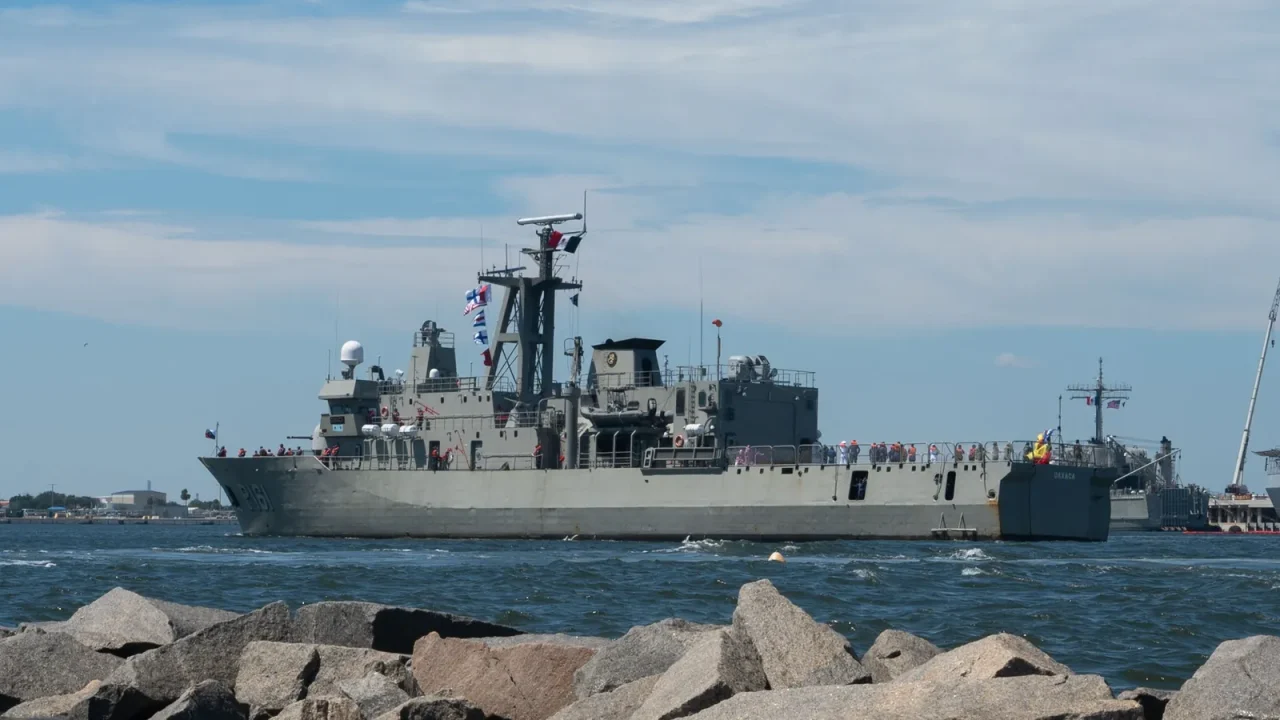
The real workhorses are the ocean patrol vessels. The ship in the photo at the top of this guide, ARM Oaxaca, is one of them. These ships are smaller than a frigate but can stay at sea for weeks. Most have a helicopter deck and carry a fast interceptor boat. That pairing is very effective: the helicopter spots a suspect vessel, and the fast boat catches it.
The landing ships
Mexico’s two big landing ships are former U.S. Navy vessels that were transferred in the early 2000s. By weight, they are among the largest ships in the fleet. Their value is not combat. It is carrying trucks, engineers, medical teams and supplies to places that have been cut off by a storm.
Mexico’s navy is built less like a spear and more like a shield and a helping hand — guarding its own waters and getting help to people fast.
Why Mexico does not have an aircraft carrier
This is not about Mexico being unable to run a navy. It is about what the navy is for. There are four big reasons.
- The mission does not need one. An aircraft carrier exists to send air power far from home. Mexico’s navy is focused on its own waters: stopping drug and fuel smuggling, protecting ports and oil platforms, fisheries patrol, and search and rescue. Patrol ships and helicopters do that job far better than a carrier could.
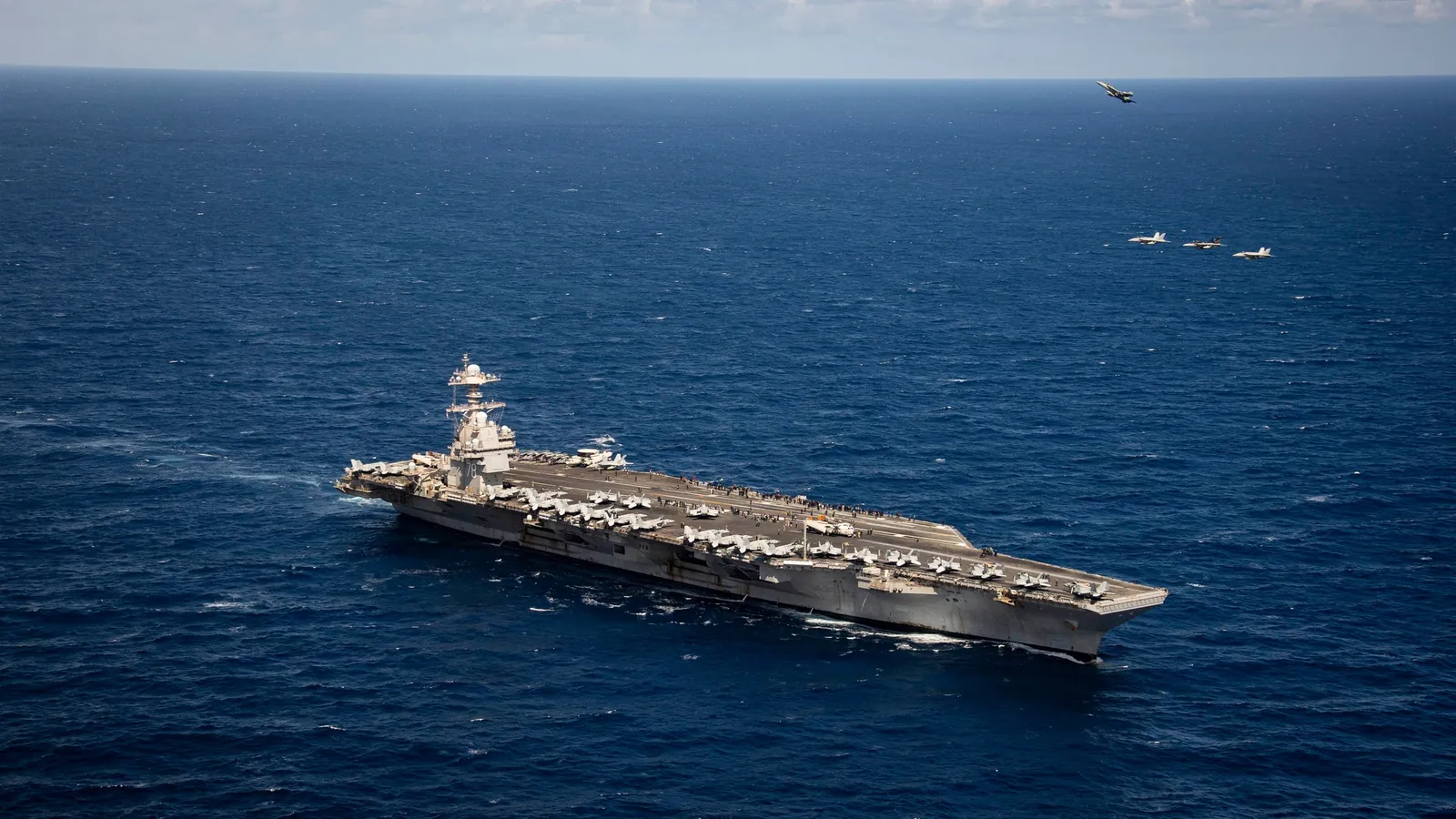
- The cost is enormous. A modern U.S. supercarrier costs around 13 billion dollars to build. Even a small carrier costs billions. Then you have to buy the aircraft, train the pilots and crew, and pay to run the ship for decades.
- A carrier needs a fleet around it. Carriers never sail alone. They need escort ships to defend them, supply ships to keep them going and aircraft built to operate at sea. Mexico would have to build an entire force around one ship.
- There is no threat that calls for it. Mexico is not involved in overseas military operations, and its defence policy has long centred on protecting its own territory. A carrier would be a very expensive answer to a question nobody is asking.
If your job is patrolling city streets, you buy patrol cars, not a long-haul truck. The truck is impressive, but it is the wrong tool. Mexico’s navy has chosen the tools that fit its work.
What the Mexican Navy does all day
It helps to see the actual job. Mexico has more than 11,000 kilometres of coastline and a huge area of sea to watch over. Here is what its sailors spend their time doing.
- Stopping smuggling. Intercepting boats carrying drugs, weapons and stolen fuel is a daily task.
- Search and rescue. The navy runs rescue stations along both coasts and saves fishermen, tourists and sailors every year.
- Disaster relief. When a hurricane hits, navy ships and helicopters bring water, food and medical teams. Mexico calls its emergency response plan Plan Marina.
- Protecting ports and oil platforms. The navy guards key ports and the offshore oil fields in the Gulf of Mexico.
- Protecting fisheries and the environment. Patrols watch for illegal fishing and pollution.
- Training with other navies. Mexican ships regularly join multinational exercises. The photo at the top was taken as ARM Oaxaca arrived in Florida for one of them in 2025.
Read that list again and ask: which of those jobs needs a carrier? None of them. That is the real answer to the question.
Mexico vs. the United States: two very different navies
Mexico and the United States share a border and two oceans, but their navies could hardly be more different. The table shows why.
| Mexican Navy | U.S. Navy | |
|---|---|---|
| Aircraft carriers | 0 | 11 |
| Main purpose | Protect home waters, law enforcement, rescue and relief | Operate worldwide and project power far from home |
| Largest warship | A frigate-sized patrol vessel | A 100,000-ton nuclear aircraft carrier |
| Nuclear-powered ships | None | All carriers and submarines |
| Submarines | None | Dozens |
| Aircraft at sea | Helicopters on patrol ships | Full air wings of jets, radar planes and helicopters |
| How it is organised | Its own cabinet ministry (SEMAR) | Part of the Department of Defense |
Neither approach is “better”. They are answers to different questions. The United States wants to be able to act anywhere on the planet. Mexico wants to keep its own coasts and waters safe. Each navy is shaped by that goal.
If you want the full picture of the American side, read our guide: how many aircraft carriers does the US have?
Which Latin American countries have had aircraft carriers?
Mexico is in good company. Very few countries in the Americas have ever operated a carrier, and only one has a flat-top ship today.
| Country | Carrier history | Today |
|---|---|---|
| Brazil | Operated two traditional carriers over the years, both bought second-hand | Operates a helicopter carrier, NAM Atlântico |
| Argentina | Operated two carriers in the second half of the 20th century | None |
| Mexico | Never operated one | None |
| Chile, Colombia, Peru and others | Never operated one | None |
Both Brazil and Argentina bought their carriers used from European navies. Both found them very expensive to keep running. Argentina gave up its last carrier in the 1990s. Brazil decided in 2017 to retire its last jet-capable carrier and now operates a ship that flies helicopters only.
The lesson is clear. Even for countries that wanted a carrier and bought one, keeping it in service was a heavy burden.
Could Mexico get an aircraft carrier in the future?
Anything is possible, but nothing suggests it is likely.
Mexico’s recent naval spending points in the opposite direction. Its plans centre on more patrol vessels, built in Mexican shipyards, along with new aircraft and helicopters for surveillance and rescue. Those are sensible choices for a navy with Mexico’s job.
If Mexico ever did want a ship that could carry several helicopters at once, the realistic option would be a helicopter carrier or large amphibious ship, not a jet carrier. Such a ship could double as a floating hospital and relief base after a disaster. Several mid-sized navies have gone that route. But as of late 2026, Mexico has announced no such plan.
Posts claiming that Mexico has “just bought” or “secretly built” an aircraft carrier appear from time to time. A purchase that large would be reported by Mexico’s navy and by major news outlets. If it is only on social media, treat it as false until proven otherwise.
Real-life situations where this question comes up
1. You saw a video online
A clip shows a huge carrier with a Mexican flag. It looks real. What to do: look for a ship name or hull number, then search for it. You will usually find the footage is from a game, a film or another country’s navy.
2. You are settling a friendly argument
A friend insists Mexico must have at least one carrier because it is such a big country. Size of country is not the deciding factor. Mission and budget are. Mexico has neither the need nor the plan for one.
3. You are writing a school report
Comparing the navies of North America makes a great project. The key point to make is that navies are designed around what a country needs them to do. Use the comparison table above and cite official sources.
4. You spotted a Mexican Navy ship in port
Mexican ships visit U.S. ports for exercises and goodwill visits, and the tall ship Cuauhtémoc draws big crowds. If you see one, check the name on the hull. Now you will know what kind of ship it is and what it does.
Common mistakes (and the fix for each)
⚠️ Mistake: Assuming every big country has an aircraft carrier.
✅ Fix: Only a handful of countries do. Most large navies in the world have none.
⚠️ Mistake: Calling a ship with a helicopter pad a carrier.
✅ Fix: Many patrol ships can land one helicopter. A carrier operates many aircraft from a full-length deck.
⚠️ Mistake: Trusting a viral image.
✅ Fix: Find the ship’s name and hull number and check them against a reliable source.
⚠️ Mistake: Thinking no carrier means a weak navy.
✅ Fix: Judge a navy by whether it can do its own job. Mexico’s is built for patrol, rescue and relief.
⚠️ Mistake: Mixing up the Mexican Navy with the army or air force.
✅ Fix: The navy is run by its own ministry, SEMAR, separate from the other services.
⚠️ Mistake: Assuming a U.S. carrier near Mexico belongs to Mexico.
✅ Fix: Carriers in the region are American. U.S. hull numbers begin with CVN.
Pro tips: how to identify any navy ship
You do not need to be an expert. A few simple clues will tell you what you are looking at.
- Find the hull number. It is painted on the bow or the side. Search for it with the country’s name and you will usually get the ship straight away.
- Look at the deck. A full-length flat deck means a carrier or a large amphibious ship. A small pad at the back means a helicopter-capable patrol ship or frigate.
- Check the flag. Warships fly their national flag at the stern.
- Use official sources. Navies publish photos and news about their own ships. Mexico’s navy does this through SEMAR.
- Compare sizes. A supercarrier is about 1,100 feet long. Most patrol vessels are under 300 feet. If the ship beside a pier looks like a floating city, it is a carrier.
Several retired U.S. aircraft carriers are now museums, including USS Midway in San Diego — a short drive from the Mexican border. Standing on the flight deck is the fastest way to understand why these ships are so rare and so costly.
Want to learn more about aircraft carriers?
If this guide has made you curious, these three picks are a good next step. We chose them by researching what each one covers and who it suits. We have not tested them hands-on, and we list the trade-offs. Read how we choose products.
| Product | Best for | Key feature | Price level | Link |
|---|---|---|---|---|
| Best overviewWorld Encyclopedia of Aircraft Carriers | Seeing every country's carriers in one book | An illustrated history from the first carriers to today | Mid-range | See on Amazon (opens in a new tab) |
| Best deep diveUS Super Carrier Operations Manual | How a modern supercarrier works | Large-format photos and diagrams | Mid-range | See on Amazon (opens in a new tab) |
| Best starter modelAcademy 1/800 USS Nimitz Model Kit | A first aircraft carrier build | A compact kit of a famous ship | Budget | See on Amazon (opens in a new tab) |
Price level is a broad guide, not a live price. Scroll the table sideways on small screens.
World Encyclopedia of Aircraft Carriers
Mid-range
A large illustrated history covering aircraft carriers from the earliest seaplane ships to modern nuclear-powered vessels, including the carriers of many different countries. If you want to know which nations have operated carriers and what those ships looked like, this is the book.
Ideal for: Readers who want the worldwide story, not just the American one.
- Covers carriers from many navies
- Heavily illustrated
- Updated edition
- Authors
- Bernard Ireland and Francis Crosby
- Format
- Hardcover
- Length
- 288 pages
- Published
- December 2023
- Page size
- about 9 x 11.4 inches
What we like
- Wide coverage in a single volume
- Good for browsing
- Recently updated
Trade-offs
- A big, heavy book
- Broad rather than deep on any one ship
- The newest ships will be missing
US Super Carrier: Operations Manual
Mid-range
A large-format hardcover from Haynes that explains how U.S. supercarriers are designed and run, from the reactors to the flight deck. It shows clearly why these ships cost so much and need thousands of people — which is exactly why so few countries own one.
Ideal for: Anyone who wants to understand what operating a carrier really involves.
- Covers design, departments and flight operations
- Sections on daily life aboard
- Photos and diagrams throughout
- Authors
- Chris McNab and Patrick Bunce
- Format
- Hardcover
- Length
- 188 pages
- Published
- August 2020
- Page size
- 11 x 8.5 inches
What we like
- Clear and visual
- Explains how the whole system works
- Makes a good gift
Trade-offs
- Published in 2020, so recent changes are missing
- Stock can run low
- Covers U.S. ships only
Academy 1/800 USS Nimitz CVN-68 Model Kit
Budget
A plastic model of USS Nimitz, the first ship of the best-known class of aircraft carriers. At 1/800 scale the finished model is roughly 16 inches long. Building it is a hands-on way to learn how a carrier is laid out.
Ideal for: First-time ship modellers and younger builders with some adult help.
- A model of the lead Nimitz-class carrier
- Compact enough for a shelf
- Unassembled plastic kit
- Brand
- Academy
- Scale
- 1/800
- Subject
- USS Nimitz (CVN-68)
- Colour
- Grey plastic
- Box size
- about 18 x 8 x 2.3 inches
What we like
- Smaller and simpler than larger-scale kits
- Lower price than premium kits
- A recognisable subject
Trade-offs
- Less detail than larger-scale kits
- Glue and paint are usually sold separately, so check the listing
- Stock can be limited
Curious about the U.S. fleet?
See the full list of all 11 American aircraft carriers and where each one is based.
Frequently asked questions
Does Mexico have an aircraft carrier?
No. The Mexican Navy has never operated an aircraft carrier and has not announced any plan to get one.
What is the biggest ship in the Mexican Navy?
Its most capable warship is the frigate-sized patrol vessel ARM Benito Juárez. By weight, its two former U.S. Navy landing ships are among the largest.
Does the Mexican Navy have fighter jets?
No. Its aircraft are helicopters and patrol planes used for surveillance, rescue and transport. Fighter jets in Mexico belong to the air force.
Which Latin American country has an aircraft carrier?
Brazil is the only one with a flat-top ship today, and it is a helicopter carrier. Brazil and Argentina both operated traditional carriers in the past.
Why does Mexico not have an aircraft carrier?
Its navy focuses on protecting Mexico’s own waters, stopping smuggling, rescue and disaster relief. Those jobs are done better and far more cheaply by patrol ships and helicopters.
How many aircraft carriers does the United States have?
Eleven, all nuclear-powered. No other country has more than three.
Your quick-reference checklist
- Mexico has no aircraft carrier and never has.
- The navy’s job is patrol, law enforcement, rescue and disaster relief.
- ARM Benito Juárez is its most capable warship.
- Several ships carry one helicopter; none carry jets.
- “ARM” means Armada de la República Mexicana.
- Brazil is the only Latin American navy with a flat-top ship today.
- Check the hull number before you believe a viral photo.
- The U.S. has 11 carriers — a completely different kind of navy.
Curious what daily life is like on a warship of any size? Read what life on a Navy ship is really like. Thinking about serving yourself? Start with how to join the Navy.
So the next time someone asks, you can answer with confidence. Mexico does not have an aircraft carrier — and when you look at what its navy actually does, it is easy to see why it has never needed one. 🌊
Sources
Facts last checked against these sources: October 2026.
- Secretaría de Marina (SEMAR): the Mexican Navy’s official site, including its missions and fleet news.
- U.S. Navy / DVIDS, September 2025: Mexican Navy patrol vessel ARM Oaxaca arrives at Naval Station Mayport for exercise UNITAS 2025.
- U.S. Navy Fact File — Aircraft Carriers (CVN): size and capability of U.S. carriers, used for comparison.
- Marinha do Brasil: the Brazilian Navy’s official site, for its current helicopter carrier.
More like this
Keep reading
How Many Aircraft Carriers Does the US Have? (2026 Guide)
The U.S. Navy has 11 aircraft carriers in service. Here is the full list, why the number is 11, what…